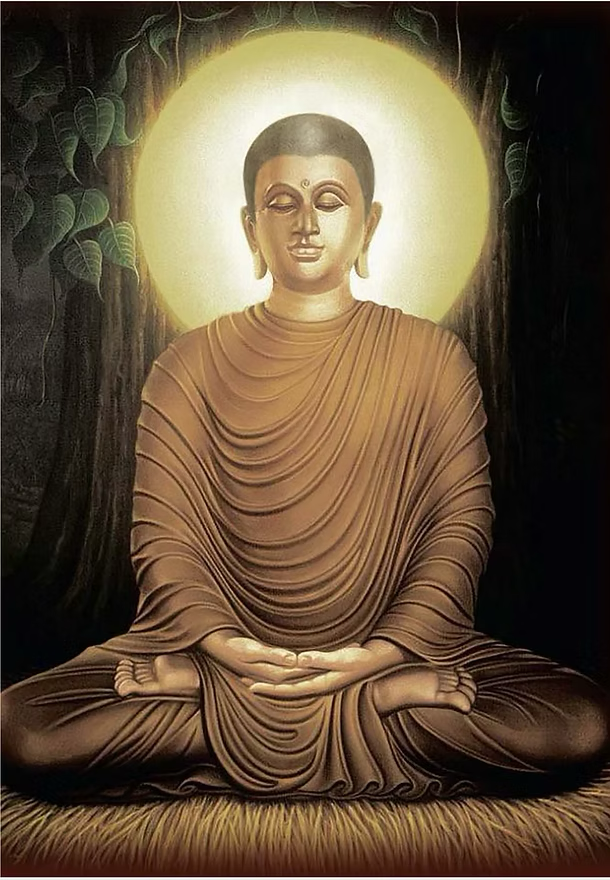
Chapter 4
The Four Noble Truths: Establishing Right View
For anyone interested to explore and study The Path of Enlightenment, one must begin with a deep understanding of The Four Noble Truths.
The Four Noble Truths is the first discourse offered by Gotama Buddha as his very first Teaching upon him attaining Enlightenment as The Fully Perfectly Enlightened Buddha.
You can study his progression and dedication to reaching Enlightenment through understanding his story that led him there. This Chapter will provide details on his actual first Teaching once he became The Fully Perfectly Enlightened Buddha and a subsequent Chapter will help you understand a portion of his life story.
The Four Noble Truths is the core understanding required to establish “Right View”. Right View gives a Practitioner’s mind the foundation in which to apply all the other Teachings and practices taught by Gotama Buddha. A Practitioner would have no ability to attain Enlightenment unless they learned, reflected, and practiced The Four Noble Truths to establish “Right View”.
The Four Noble Truths explains the wisdom of discontentedness, the wisdom of the cause of discontentedness, the wisdom of the elimination of discontentedness, and the wisdom of the way of practice leading to the elimination of discontentedness.
In four (4) simple statements, Gotama Buddha shares the problem with the unEnlightened mind, the cause of the problem, the elimination of the problem, and the path leading to the complete elimination of the problem.
Before we explore The Four Noble Truths in The Words of The Buddha, I will first share a summarized version of this Chapter to provide you a high-level understanding of The Four Noble Truths and related Teachings to prepare the mind for deeper investigation of this Teaching.
The content in the following table will help you get a basic understanding of The Four Noble Truths and related Teachings.
82
Understanding and practicing “The Four Noble Truths” is the first step towards The Path to Enlightenment, Nibbāna, and a Higher Consciousness. The Four Noble Truths is the first step of “The Eight Fold Path” called "Right View”. The Eight Fold Path is The Path to Enlightenment with the other Teachings from Gotama Buddha connecting into this path. Impermanence: Everything is constantly changing and there is no permanent state. Material objects/possessions, relationships, thoughts, ideas, states of mind, everything in the world is constantly changing. All conditioned feelings will cease to exist. All that arises will cease to exist. There is no steady, constant, or fixed mental state other than Enlightenment. Discontentedness: Gotama Buddha describes three feelings as discontent or “Dukkha” due to their nature of being based on impermanent conditions. The goal of these Teachings is to eliminate discontentedness of mind providing the mind a permanent place to reside in Enlightenment. - A pleasant feeling (happiness, excitement, elation, thrill, exhilaration, euphoria, etc.) Craving/Desire/Attachment/Wants/Expectations/Grasping/Holding/Clinging: a mental longing for something with a strong eagerness. The mind pulling in a direction for objects of its affection. The Four Noble Truths —> “Right View” 1.) First Noble Truth: Everyone that is unEnlightened will experience discontentedness. 2.) Second Noble Truth: Discontentedness is caused by our own cravings/desires/attachments because the mind wants everything to be permanent when everything in the world is impermanent. 3.) Third Noble Truth: The elimination of discontentedness is possible by eliminating cravings/desires/attachments. 4.) Fourth Noble Truth: The path to eliminating discontentedness is The Eight Fold Path. The goal in life is not to be happy, as that is an impermanent feeling. When the mind is not happy, it will move to sadness, anger, or worse. The goal in life is to develop a peaceful, calm, serene, and content mind with joy free of cravings/desires/attachments that is “satisfied with what is….” - the Enlightened mind. The Enlightened mind will not base its inner feelings on impermanent conditions therefore it is a permanent mental state. The Enlightened mind is unconditioned. |
83
|
Author’s Thoughts: The Four Noble Truths can be summarized and understood in the following way. You need to accept responsibility for your own discontent mind and the emotions you experience. Rather than blaming pleasant feelings, painful feelings, and feelings that are neither painful-nor-pleasant on someone or something external, see the truth that you cause your own discontent mind. See the truth that your own mind is causing itself to experience these unwelcome feelings. By observing the truth that you are the problem, the next step is that you have the ability to resolve the problem. By accepting responsibility for your own discontent mind, you then have 100% ability to eliminate discontentedness in the mind through understanding and practice of these Teachings. Because if you are the cause of the discontent mind, that means you have the ability to eliminate and resolve the discontentedness in the mind. You have 100% ability to attain a content mind through learning and practicing these Teachings. The way leading to the complete elimination of discontentedness in the mind and attaining a peaceful, calm, serene, and content mind with joy is to learn and practice “The Eight Fold Path”. The Enlightened mind will be calm and relaxed yet attentive and alert. The mind will be concentrated, steady, and unshakable. Understanding The Four Noble Truths is the first step towards a content and peaceful mind and life. Right View is the first step of The Eight Fold Path. Without accepting responsibility for the discontent mind, you will never be able to take steps to resolve the discontentedness in the mind because of the “wrong view” that something or someone else is causing the mind to be discontent means you feel that you have no ability to attain a content mind. If it is others who are causing you to experience discontentedness, then you will need to train the entire world to do things your way. You are unable to train the entire world to do things the way of your choosing. Therefore, with “wrong view” you will always experience discontentedness in the form of pleasant feelings, painful feelings, or feelings that are neither painful-nor-pleasant. You may find that you are attempting to train others to do things your way rather than train your mind to understand The Natural Laws of Existence. However, since it is impossible to train everyone in the entire world to react and respond to you in the way of your choosing, you need to train the mind to be peaceful, calm, serene, and content with joy to no longer experience discontentedness in any and all situations. You have the ability to change your own mind through training but you have no ability to change the mind of another person. The problem is not the outside world, but the inner world. Training the mind (inner world) is what produces a peaceful existence. You cause your own sadness, anger, frustration, irritation, annoyance, guilt, shame, fears, boredom, loneliness, shyness, jealousy, resentment, stress, anxiety, and all other discontent feelings. Because you are the cause of these discontent feelings, this means that you can eliminate the discontent feelings through understanding and practice of these Teachings. |
84
|
Author’s Thoughts (continued): These Teachings are a “life practice” to establish an understanding and to practice Teachings that eliminate 100% of the discontentedness in the mind. The first step is to understand The Teachings intellectually, reflect on these Teachings, then observe these Teachings in practice so that you can attain the wisdom and truth in The Teachings. Through the wisdom you acquire in the practice of these Teachings, you will liberate the mind through wisdom to experience Enlightenment, Nibbāna, a Higher Consciousness. This new found wisdom “gradually” improves the way the mind functions in the world through how the mind interacts in the world and will eliminate discontentedness of mind. When the mind attains Enlightenment, the mind will not experience any discontentedness. The mind will be peaceful, calm, serene, and content with joy - permanently. |
Now that you have an introduction to The Four Noble Truths, let me explain in more detail.
Let’s first discuss The Three Universal Truths as these are foundational Teachings that one needs to learn, reflect on, and practice to be able to understand The Four Noble Truths
We refer to these Teachings as The Three Universal Truths and The Four Noble Truths. Gotama Buddha knew they were the truth and Enlightened beings know they are the truth, but in order to attain Enlightenment you will need to know they are the truth through learning, reflecting, and practicing these Teachings with guidance from a Teacher to observe the truth to acquire wisdom.
As the mind acquires more and more wisdom in this way, the mind will gradually awaken to “true reality” no longer struggling to understand the world and what happens in the world. The mind will awaken to the wisdom of The Natural Laws of Existence that were explained by Gotama Buddha.
85
There are “The Three Universal Truths” that are important to understand.
1.) Impermanence (Pāli: anicca)
2.) Discontentedness (often translated as suffering) (Pāli: dukkha)
3.) Non-Self (Pāli: anattā)
1.) The Universal Truth of Impermanence is a crucial Teaching to understand as it relates to understanding Gotama Buddha’s Teachings of the world he describes and then offers a path forward.
Impermanence is the understanding that all things are constantly changing.
Nothing in the world is permanent except for The Natural Laws of Existence and the mental state of Enlightenment. Material objects/possessions, relationships, thoughts, ideas, feelings, states of mind, everything in the world is constantly changing. All conditioned feelings will cease to exist. All that arises will cease to exist. There is no steady, constant, or fixed mental state other than Enlightenment.
If you take a moment to explore the mind and the world around you, you can observe that this is, in fact, a universal “truth”. You have had multiple jobs, relationships, countless clothing and possessions. Your hair continuously grows and you never can keep it forever, it leaves the body every moment.
Nothing in your life has stayed with you forever and is constantly changing, including the physical body itself. The body has constantly changed from birth until now and will continue to change your entire life. You will need to leave the body at some point. Nothing truly belongs to you as you are only using everything temporarily and everything will leave us someday because it is all impermanent. You cannot keep anything, material objects/possessions, relationships, thoughts, ideas, or feelings permanently.
Your emotions and mental states are also impermanent. The mind will change from pleasant feelings, to painful feelings, to feelings that are neither painful-nor-pleasant through your life and oftentimes throughout your day. There is no emotion or mental state that is permanent - only Enlightenment is permanent.
Enlightenment is the only mental state that is permanent. It is a mental state for the mind to exist permanently because the mind is liberated by wisdom. Once you learn The Natural Laws of Existence and deeply understand them through practice, you will not unlearn or forget this wisdom. Thus, Gotama Buddha gave us Teachings that provide a permanent place for the mind to
86
reside peaceful, calm, serene, and content with joy - fully protected from the ups and downs of life where a Practitioner will enjoy life more fully.
Other examples of how you can observe impermanence in the world are: there will never be a time when 100% of all people in the world understand you are a loving and kind person who only has an interest to live peacefully. That would be permanence and it does not exist. Oftentimes, the mind wants everyone to understand you and attempts to convince others of something. This is not accomplishable as not everyone is going to understand you because that would be permanence.
Not everyone is going to agree with your opinions and views. There are going to be some people who agree with you and others who disagree. There will never be a time when 100% of all people agree with you due to The Universal Truth of Impermanence. So, does it make sense to adamantly argue with someone to convince them to agree with you when you know this is not possible? Or, instead, one could have a peaceful discussion to share an opinion if others are interested to understand recognizing that not everyone will understand and not everyone will agree.
The mind needs to deeply understand The Universal Truth of Impermanence and will need to observe this in the world for itself to acquire wisdom. So, look around and see for yourself if you can find something that is permanent.
Is the sidewalk permanent? Is it the same color, shape, or texture throughout the entire city or town where you live? Does the sidewalk remain solid or does it have cracks? This is impermanence.
Is the weather permanent? Do we experience the same temperature, wind conditions, and precipitation every day? This is impermanence.
Is a tree permanent? Are the leaves the same color, shape, or texture? Does the tree remain the same shape permanently or is it constantly changing? This is impermanence.
Impermanence is a Universal Truth and the more you look around in the world, the more you will come to understand this truth to acquire wisdom.
This is a foundational Teaching that will help you understand The Four Noble Truths and the problems within the unEnlightened mind and why you have not been able to experience permanent happiness in your life. Happiness is impermanent.
87
2.) The Universal Truth of Discontentedness is how the unEnlightened mind has conditioned feelings based on impermanent conditions. The unEnlightened mind will base its inner feelings on impermanent conditions leading to conditioned pleasant feelings, painful feelings, and feelings that are neither painful-nor-pleasant.
The words discontent, discontented, and discontentedness can capture the full essence and meaning of what is mostly described across books and writings about Gotama Buddha’s Teachings where you see the word “suffering” substitute the word “discontentedness”. Where you see the word “Dukkha” substitute the word “discontentedness”.
Gotama Buddha’s Teachings, that lead to Enlightenment, are meant to allow you to find a content mental state that is in the middle, so that the mind is not affected by impermanence to become “discontent” (oftentimes discussed as “suffering”).
The word “suffering” is often translated from the word “Dukkha”, used by Gotama Buddha, which you will see if you are studying Gotama Buddha’s Teachings in the Pāli language, if you speak with Ordained Practitioners, or other places in your journey with Gotama Buddha’s Teachings.
Oftentimes the word “suffering” is used in the English language to represent the subject Gotama Buddha discussed in the Pāli language as “Dukkha”. However, I have found that the word “discontentedness” is a much better word to understand and use. This word represents much more than the word suffering.
The word suffering tends to only bring one’s mind to think of physical or emotional “pain”. It does not capture the full range of mental feelings that exist in one’s experiences of daily life. The word “suffering” is ineffective in bringing a Practitioner’s mind wholly to the understanding shared by Gotama Buddha. The word suffering will not bring a Practitioner’s mind to establishing “Right View” as described by Gotama Buddha which is needed to attain Enlightenment. Thus, offering the word “discontentedness” will assist a Practitioner to gain the insight needed for establishing a foundation for further studies and ultimately to attain Enlightenment.
Discontentedness describes the mental state when the mind is unsatisfied, displeased, uncalm, or unpeaceful. The mind is shaken up, unsteady, or unstable.
Discontentedness is impermanent but it continues to happen over and over again because the conditions that are causing the discontentedness still remain in the unEnlightened mind. The Path to Enlightenment is to train the
88
mind to eliminate the conditions that are causing the discontentedness through dedicated learning, reflecting, and practice of these Teachings.
Discontentedness is a mental state that can arise from physical or emotional pain through to the slightest unpleasantness of a small odor or slightest of touches when unpleasant feelings arise. It describes the mental state that can arise from extreme physical discomfort through to the smallest of needle pricks, emotional unpleasantries or significant traumas and effects of the mind. Discontentedness also describes the condition of the mind when there are feelings of happiness, excitement, elation, thrill, exhilaration, euphoria, boredom, loneliness, shyness, displeased, uncomfortable, unsatisfied, and others in the mind.
Discontentedness is a state of being, not a feeling or emotion itself.
When the mind is excited and elated, the mind is uncalm where one does not have concentration.
The Enlightened mind is beyond pleasure and pain where instead of experiencing conditioned happiness, excitement and elation based on an impermanent condition, it will instead experience permanent joy no longer attaching its inner feelings to impermanent conditions.
Gotama Buddha describes three feelings as discontent. This is referred to as The Universal Truth of Discontentedness.
The goal of these Teachings is to eliminate discontentedness of mind providing the mind a permanent place to reside in the mental state of Enlightenment.
- A pleasant feeling (happiness, excitement, elation, thrill, exhilaration, euphoria, etc.)
- A painful feeling (sadness, anger, frustration, irritation, annoyance, guilt, shame, fear, stress, anxiety, etc.)
- A feeling that is neither painful-nor-pleasant (boredom, loneliness, shyness, displeased, uncomfortable, unsatisfied, etc.)
Happiness can be described as discontentedness because we know those feelings and pleasures will not last - they are impermanent. Once the pleasant feelings cease to exist, the mind then oftentimes moves to painful feelings of sadness, anger, or worse. The mind continues to go through this constant cycle of chasing pleasant feelings, then experiencing painful feelings and feelings that are neither painful-nor-pleasant experiencing discontentedness struggling in life.
89
All three of these feelings can be experienced in the unEnlightened mind which can be described as discontentedness. If we use the word “suffering”, as has been used in the past, it only describes 1/3 of the meaning of “dukkha” originally taught by Gotama Buddha. Suffering describes a painful feeling but it does not describe the other two (2) types of “dukkha” or feelings taught by Gotama Buddha. Using the word suffering, a Practitioner would be missing 66.6% of what Gotama Buddha was discussing to eliminate from the mind, thus, finding it very challenging to ever experience Enlightenment.
Discontentedness is experienced through The Six Sense Bases. The eyes, ears, nose, tongue, body, and the mind. These are the six internal sense bases or the six internal sense faculties. You will see different people using different language to describe Gotama Buddha’s Teachings because even how people describe these Teachings is impermanent. It is not steady, fixed, or constant as different people choose to use different language.
The six internal sense bases experience the six external sense bases of forms, sounds, odors, flavors, physical objects, and mental objects.
The mind longing for pleasant feelings through the six internal sense bases for the six external sense bases is one of the significant problems of the unEnlightened mind described in The Ten Fetters as “sensual desire”. The mind is chasing after pleasant feelings through The Six Sense Bases looking to fulfill the objects of its desires through impermanent conditions.
The mind experiences discontentedness through longing for sensual pleasure through these six (6) sense bases.
The Six Sense Bases
| Internal Sense Base | External Sense Base |
| Eyes | Forms |
| Ears | Sounds |
| Nose | Odors |
| Tongue | Flavors |
| Body | Physical Objects |
| Mind | Mental Objects |
90
When seeing an agreeable form through the eyes, one experiences pleasant feelings. When seeing a disagreeable form through the eyes, one experiences a painful feeling. The mind is discontent.
When hearing an agreeable sound through the ears, one experiences pleasant feelings. When hearing a disagreeable sound through the ears, one experiences a painful feeling. The mind is discontent.
When smelling an agreeable odor through the nose, one experiences pleasant feelings. When smelling a disagreeable odor through the nose, one experiences a painful feeling. The mind is discontent.
When tasting an agreeable flavor through the tongue, one experiences pleasant feelings. When tasting a disagreeable flavor through the tongue, one experiences a painful feeling. The mind is discontent.
When touching an agreeable physical object through the body, one experiences pleasant feelings. When touching a disagreeable physical object through the body, one experiences a painful feeling. The mind is discontent.
When recognizing an agreeable mental object through the mind, one experiences pleasant feelings. When recognizing a disagreeable mental object through the mind, one experiences a painful feeling. The mind is discontent.
Mental objects are mental states. A mental state is a mental quality in which the qualities of the mind are constant even though the state itself may be dynamic (i.e. changing).
Through all six (6) sense bases or The Six Doorways to Discontentedness, the mind experiences pleasant feelings, painful feelings, and feelings that are neither painful-nor-pleasant. When pleasant feelings, painful feelings, and feelings that are neither painful-nor-pleasant are experienced, the mind is discontent. There are more detailed Teachings on this topic in the book “The Six Sense Bases” (Volume 9) in this same book series.
As the mind chases pleasant feelings, due to the impermanent nature of these feelings, the mind is then inviting in painful feelings and/or feelings that are neither painful-nor-pleasant as the mind still has a longing with a strong eagerness for impermanent conditions to create pleasant feelings. If the mind is basing its inner pleasant feelings on impermanent conditions, it is also going to experience painful feelings and feelings that are neither painful- nor-pleasant based on impermanent conditions. Instead, the mind can be trained to be inwardly peaceful and calm no longer yearning for pleasant feelings through conditions which are all impermanent.
91
If the mind is unwilling to let go of impermanent conditioned happiness, it will never experience permanent unconditioned joy of the Enlightened mind.
To attain Enlightenment, you will need to learn how to “guard” the doorways to discontentedness and “protect your own contentedness” through developing a life practice of non-craving, non-desire, non- attachment, or non-clinging. We are each responsible to “protect or maintain our own contentedness of mind”, no one else can do that for us.
Since the mind is not resting in one of these three (3) feelings permanently, due to the internal feelings being based on impermanent conditions, the mind is experiencing discontentedness.
The goal of Gotama Buddha’s Teachings and pursuing Enlightenment, is for the mind to be content which is a permanent place the mind can reside through liberation of the mind. The mind will be liberated from basing its internal feelings on impermanent conditions residing permanently peaceful, calm, serene, and content with joy. To accomplish this, one needs to observe the truth in Gotama Buddha’s Teachings to acquire wisdom through your practice of The Teachings and then deeply training the mind.
We acquire wisdom through learning and practicing The Teachings to observe the same “truths” as Gotama Buddha. The collection of this wisdom leads to improved ways for the mind to function optimally with purity of thought and awakened to attain Enlightenment.
Enlightenment is a permanent place for the mind to reside because once you learn something to acquire wisdom you do not “unlearn” it. You learn through experience and observation of The Teachings through practice of The Teachings. There is no belief in these Teachings and practices but instead experiential learning where you observe the truth in The Teachings that becomes wisdom. Liberation of the mind by wisdom (i.e. Enlightenment) is the only mental state that is permanent. Enlightenment is a mental state where the mind can reside permanently peaceful, calm, serene, and content with joy.
We will now use the word discontent, discontented, or discontentedness, rather than suffering or dukkha, throughout this book.
92
3.) The Universal Truth of Non-Self is a Teaching that needs to be realized in the mind that there is “no permanent self” through learning, reflecting, and practicing to eliminate the mind’s misunderstanding that there is a permanent self.
The unEnlightened mind will falsely identify the body and/or the mind as being “the self”. There is a self image and self identity that the mind is oftentimes interested to project and then protect. The misunderstanding that the mind has thinking there is a permanent self leads to the mind continuously wanting to protect the self image and self identity being unable to remain peaceful and calm when there is a disagreeable experience related to the self image or self identity.
For example, if someone comments about the self image or self identity in a way that the mind agrees with, the mind can experience pleasant feelings. But, if someone comments about the self image or self identity in a way that the mind disagrees with, the mind can experience painful feelings.
The mind falsely associates the physical body and its appearance as being “who you are”. The mind thinks that this body or the mind is “you” and therefore goes out of its way to mentally protect itself when it meets with disagreeable experiences.
When the mind holds on to a permanent self, one can oftentimes become very selfish, self centered, self absorbed, and pursue its own selfish desires. This inhibits a person from being able to observe the life changing wisdom that we are all interconnected and need to improve the way we function in the world through giving and sharing living harmoniously with each other.
As long as the unEnlightened mind falsely associates with the physical body and/or mind as being the self, who “you” are, thinking the body or mind is “you”, then the mind cannot reside peaceful, calm, serene, and content with joy because the mind will be fearful and protective of this permanent self. The mind will become angered, frustrated, or worse as it experiences disagreeable situations related to the self image and self identity.
But this is a misunderstanding of the unEnlightened mind and as long as it holds on to this false belief that there is a permanent self, the mind cannot reside peaceful and calm as it will always be fearful and looking out with strategies of protection from perceived enemies and disagreeable experiences.
An animal needs to retain the concept of a permanent self in the mind as this is how it protects itself in the wild and ensures survival. But, as human beings, we can reside in the human existence more peacefully through
93
realizing that we do not need to hold on to this concept or belief of a permanent self and, thus, will eliminate a massive amount of fears, unwholesome protective habits, and discontentedness in the process of letting go to realize “non-self”.
What truly exists is a physical body and a mind that has come together for this unique existence. At birth, we were provided a name, a label, that then makes it easy for everyone to refer to this unique body and mind combination in this existence. The given name lets everyone know “who we are” and we can more easily attend to our daily activities roaming and wandering about the earth.
But then, the unEnlightened mind starts to form a self image and self identity based on this name that has been given to label the unique existence of this body and this mind. The mind forms the false perception that this body is you or that this mind is you. The mind experiences feelings and thinks that is you and who you are. The mind gets tangled up misunderstanding that there is a self because it lacks the wisdom it needs to see clearly that there is no self.
Oftentimes people get so confused that at some point during life one might proclaim they need to go “find themselves” or they are going to go try to “discover their true self”. One might say, “they do not even know who they are anymore”.
This might lead to a journey where they unplug from society or go on a journey through education, travel, and other experiences seeking to understand who they truly are as they are not able to identify a “true self”. One might remain conflicted for many years over who they are becoming experiencing boredom, loneliness, or other discontent feelings due to not being able to find or understand “the self”. The mind is searching and yearning to discover a self but it can never find one though it continues its pursuit seeking to know and find a self because the mind does not realize there isn’t one. There is no self yet the mind’s misunderstanding thinking there is a self can cause the mind to grow increasingly conflicted and struggle.
This can cause one’s life to come crashing down around them because they are seeking to find a self but a self does not actually exist. They are on a never ending journey to find something that does not actually exist.
94
The only way out of this constant struggle is to deeply understand there is “no self” through understanding The Universal Truth of Non-self coming to realize that the mind can reside more peaceful, calm, serene, and content with joy when it is not falsely identifying the physical body or the mind as being a permanent self.
Is the body permanent or impermanent?
Is the mind permanent or impermanent?
So, if the body is impermanent and the mind is impermanent, where is this permanent self that the mind wants to “hold on” to? The answer is, there is no permanent self but the unEnlightened mind thinks there is one and this is a misunderstanding that the mind has, thus, causing it problems in the world through fears, unwholesome protective habits, and oftentimes becoming quite selfish being unable to share with others claiming ownership of everything around us. The false understanding or ignorance (unknowing of true reality) that the unEnlightened mind has related to The Universal Truth of Non-self and all these other Teachings sends it into a constant cycle of trying to fulfill or please the mind with pleasant feelings but it keeps ending up with repeated discontentedness.This can all be remedied through learning, reflecting, and practicing Teachings to eliminate this misunderstanding, misperception, and false belief in the mind that there is a permanent self.
This comes with consistent learning and practice with guidance from a Teacher. A Practitioner will need to first have a well developed life practice of The Eight Fold Path which includes meditation. These core and central Teachings help prepare the mind to get to a point where it can more clearly see “there is no self” and be prepared to “let go” of its misunderstanding that there is a permanent self.
Oftentimes when one is learning The Universal Truth of Non-self, the Practitioner does not immediately understand it and even if they did, it would still take a well developed practice of many other Teachings to get to the point where the mind will be willing to let go of “the self” realizing non-self which is to eliminate the fetter/taint/pollution of mind described in The Ten Fetters as “personal existence view”.
Eliminating “personal existence view” to realize “non-self” will be discussed further in the Chapter titled “Dissolving The Ego: Ego Serves No Purpose” (Chapter 16).
95
Now, onto The Four Noble Truths.
The Four Noble Truths are offered throughout literature of Gotama Buddha’s Teachings in many forms. It is rare to see the same translation or wording from any two sources due to impermanence.
The below are The Four Noble Truths as translated from The Pāli Canon, the original and most complete source of Gotama Buddha’s Teachings.
96
The Four Noble Truths Monks, there are these Four Noble Truths. What four? The noble truth of discontentedness, And what, Monks, is the noble truth of discontentedness? It should be said: The Five Aggregates subject to clinging; that is, the form aggregate subject to clinging, the feeling aggregate subject to clinging, the perception aggregate subject to clinging, the volitional formation aggregate subject to clinging, the consciousness aggregate subject to clinging. This is called the noble truth of discontentedness. And what, Monks, is the noble truth of the cause of discontentedness? It is this craving which leads to renewed existence, accompanied by excitement and desire, seeking excitement here and there; that is craving for sensual pleasures, craving for existence, craving for extermination. This is called the noble truth of the cause of discontentedness. And what, Monks, is the noble truth of the elimination of discontentedness? It is the remainderless fading away and elimination of the same craving, the giving up and letting go of it, freedom from it, non-reliance on it. This is called the noble truth of the elimination of discontentedness. And what, Monks, is the noble truth of the way leading to the elimination of discontentedness? It is this Noble Eight Fold Path, that is, Right View, Right Intention, Right Speech, Right Action, Right Livelihood, Right Effort, Right Mindfulness, Right Concentration. This is called the noble truth of the way leading to the elimination of discontentedness. These, Monks, are The Four Noble Truths. Therefore, Monks, an effort should be made to understand: ‘This is discontentedness’; an effort should be made to understand: ‘This is the cause of discontentedness’; an effort should be made to understand: ‘This is the elimination of discontentedness’; an effort should be made to understand: ‘This is the way leading to the elimination of discontentedness.’ (Gotama Buddha) (Reference: SN 56.13) |
97
The following text of The Four Noble Truths is a Teacher’s explanation to assist a Practitioner’s learning rather than an attempt at a direct translation of Gotama Buddha’s actual words.
The remaining part of this chapter will be dedicated to helping you to understand The Four Noble Truths in a way that allows you to understand, reflect, and practice this important Teaching to establish Right View.
First Noble Truth: Everyone that is unEnlightened will experience discontentedness. (The noble truth of discontentedness.)
In the first noble truth Gotama Buddha explains discontentedness. There is no permanent peacefulness, calmness, serenity or contented state with joy in the mind other than Enlightenment.
All unEnlightened beings will experience discontentedness. If you experience discontentedness which is a pleasant feeling, a painful feeling, or a feeling that is neither painful-nor-pleasant, then you know the mind is unEnlightened.
If the mind experiences:
- A pleasant feeling (happiness, excitement, elation, thrill, exhilaration, euphoria, etc.)
- A painful feeling (sadness, anger, frustration, irritation, annoyance, guilt, shame, fear, stress, anxiety, etc.)
- A feeling that is neither painful-nor-pleasant (boredom, loneliness, shyness, displeased, uncomfortable, unsatisfied, etc.)
…then, you know the mind is discontent and unEnlightened.
There are plenty of unEnlightened beings in the world and is why we experience so many struggles in daily life. The Path to Enlightenment is for you to eliminate discontentedness in the mind so that it can reside peaceful, calm, serene, and content with joy - permanently.
With continued learning, reflection, and practicing of these Teachings, the mind will move closer to the Enlightened mind.
Experiencing all three of these feelings it can be described as the mind is discontent, discontented, or experiencing discontentedness.
98
Happiness (i.e. pleasant feelings) is based on an impermanent condition, therefore, it is impermanent - it is unsatisfying and displeasing. If there is conditioned happiness (i.e. pleasant feelings), it is only a matter of time before the mind experiences painful feelings or feelings that are neither painful-nor-pleasant. The mind will continue to experience discontentedness as long as it has craving/desire/attachment for conditioned pleasant feelings. Painful feelings and feelings that are neither painful-nor-pleasant are right around the corner waiting to invade the mind.
An Enlightened mind will experience joy that is beyond pleasure and pain. The joy will not be conditioned on an impermanent object, therefore, it will be permanent. An Enlightened being wakes up joyful, is joyful all day long, and goes to sleep joyful. An Enlightened being can enjoy much more out of life because the mind is never discontent, it is deeply trained to no longer base its inner feelings on some impermanent condition.
Discontentedness does not arise in an Enlightened mind.
All beings in the unEnlightened state experience discontentedness of mind through pleasant feelings, painful feelings, and feelings that are neither painful-nor-pleasant.
This could be perceived as a pessimistic view however, in order to achieve contentedness, a Practitioner will need to first understand the discontentedness in the mind so that with this Right View, a Practitioner can clear their own discontented state of mind.
If we view the mind, and thus the world as correct, healthy, and a pleasant place to be then there is no reason to change or adjust our state of consciousness. It’s through observing the mind and what humans have created in the world as undesirable that we bring the mind to the understanding that we need change.
We certainly feel enjoyment, pleasure, and have had plenty of pleasant experiences in life. However, you have also experienced grave suffering or mild suffering that if you had the choice, you would not want to repeat. The purpose of pursuing Enlightenment is to eliminate discontentedness in the mind and ensure that there is not rebirth into the world to experience the misery of a new existence. In this way you can experience a peaceful, calm, serene, and content mind with joy and, thus, a peaceful life. You can escape The Cycle of Rebirth and experience a better way of life through the pursuit of Enlightenment.
An Enlightened mind will enjoy the rest of their life with complete peace and calmness of mind.
99
Look at what is in the mind this very moment along with the past or future thoughts you are having. What do you see? If you are honest with yourself, you will see discontentedness, suffering, a lifetime of accumulated discontentedness. This is normal and the state of mind prior to the pursuit of Enlightenment and for someone unaware of the solution. Your discontentedness continues over and over without the ability to understand it or resolve it until you have learned and practiced The Teachings of Gotama Buddha.
Further, if you look at the world around you carefully, a well learned eye should start to see discontentedness everywhere. Not just in your own life, but in the life of most people around you. You should see that everyone you know, no matter how happy of a face they portray, has discontentedness of one form or another unless they have attained Enlightenment. All people who are unEnlightened will experience discontentedness of mind, however the most important understanding and focus should be on your own mind. You can resolve the discontentedness in your own mind but you cannot resolve the discontentedness of someone else’s mind, only they can do that.
When we see the world as an undesirable place to exist, we will naturally be interested to seek refuge or protection in a higher state of consciousness, thus, seek Enlightenment - the ultimate goal of Gotama Buddha’s Teachings.
We cannot run from this world or all that has accumulated in the mind, so the only answer is to seek Teachings, understanding, and protection in the further progress towards emptying the mind on The Path to Enlightenment. You will often see phrasing such as “seek refuge in the dharma”. “Dharma” or in Pāli “Dhamma”, are The Teachings of Gotama Buddha.
By seeking refuge, you are seeking understanding, insight, knowledge, wisdom, and ultimately as you pursue Enlightenment you will have safety of the mind through protection of The Teachings and wisdom you have acquired. The mind will be protected by Gotama Buddha’s Teachings to protect against the world of discontentedness. The mind will be liberated by wisdom. The mind will experience the fading away of strong feelings and ultimately freedom from strong feelings as it is liberated from the problems it encounters through making decisions with pollution of the mind.
Through the process of learning and emptying the mind, you will attain a purer and purer mind, thus, a more stable, content, and peaceful existence. The mind will be purified from the fetters/taints/pollution and, thus, all discontentedness can be eliminated but one must understand what is causing the discontentedness and how to eliminate it which is explored in the remaining portion of The Four Noble Truths.
100
Now, let’s explore why the impermanent nature of everything in the world causes the mind to be discontent.
Second Noble Truth: Discontentedness is caused by our own cravings/desires/attachments because the mind wants everything to be permanent when everything in the world is impermanent. (The noble truth of the cause of discontentedness.)
With the understanding that the unEnlightened mind is full of discontentedness, we now explore the second noble truth which details the cause of the discontentedness.
The cause of our discontentedness is that the unEnlightened mind has cravings/desires/attachments, mental longing with a strong eagerness, wanting things to be permanent when everything is impermanent except for Enlightenment and The Natural Laws of Existence. This is how the mind pulls in the direction towards the objects of its affection.
The mind has craving/desire/attachment to “things” including the “things” of the past or the future. Our expectation is that things are permanent and when they are not, discontentedness occurs. When the mind has mental craving/desire/attachment, longing with a strong eagerness for “things” that are impermanent while we expect them to be permanent, the mind will cause itself to become discontent because it “wants” permanence.
This is why when there is a relationship that has ended, the mind experiences sadness, anger, frustration, irritation, boredom, loneliness, or other discontent feelings. The mind wanted the relationship to be permanent and when it was not, the mind experiences discontentedness in the form of painful feelings.
Whether the relationship ended due to a disagreement, moving away from each other, death, or some other cause, the unEnlightened mind wanted the relationship to be permanent and when it wasn’t, the mind experienced discontentedness. The unEnlightened mind does not understand impermanence and is not trained to be comfortable with impermanence and, therefore, causes itself to be discontent.
If an unEnlightened mind purchases a brand new shiny sports car and drove it to a store, parked and then went into the store returning to a scratch on the car, one person could get angry or enraged blaming others for this anger and looking to settle this through hostility and aggression. Or, a person could exit the store observing the scratch on the car understanding impermanence and be thankful that they have insurance or otherwise plan to get the car fixed - remaining calm, steady, and stable with an understanding that the car
101
is impermanent and it is impossible for it to permanently be a brand new shiny sports car.
In both scenarios, the scratch was the same but one person’s mind reacted to the situation with ignorance (unknowing of true reality) of impermanence and the mind is causing itself to be discontent due to craving/desire/ attachment while the other person chose to respond understanding impermanence and made wise choices to get the car repaired. So, the cause of the discontentedness was not the scratch or the person who created the scratch or else, both people would have the same experience.
The cause of discontentedness is that the unEnlightened mind has craving/desire/attachment wanting to keep things permanently and when it encounters impermanence, the mind becomes discontent.
The mind is causing itself to be discontent due to its own mental longing with a strong eagerness wanting things to be a certain way referred to as craving/desire/attachment.
There is never a time where a relationship is going to be permanent or that one’s possessions will remain in a permanently pristine condition. Therefore, as long as the mind is unaware and unknowing of The Universal Truth of Impermanence and The Four Noble Truths, not practicing these Teachings to train the mind, the unEnlightened mind will continue to struggle experiencing an untold amount of discontentedness throughout life.
Craving/desire/attachment/wants/expectations/grasping/holding/clinging are all words that we use to describe how the mind yearns or longs for something with a strong eagerness. The unEnlightened mind thinks that if it just gets the objects of its affection that it will have what it needs, will provide inner fulfillment, and it can rest.
But, the mind continually chases after the objects of its affection wanting and desiring pleasant feelings. Upon acquiring the objects of its affection or whatever it is obsessing over, the mind experiences pleasant feelings (happiness, excitement, elation, thrill, exhilaration, euphoria, etc.). Because those feelings are impermanent (i.e. temporary) the mind continues its chase after the pleasant feelings through the next object of its affection experiencing the burden of carrying craving/desire/attachment deep in the mind oftentimes experiencing headaches, tiredness, or heaviness, etc. as it carries the burden of craving/desire/attachment throughout the day.
Craving and desiring pleasant feelings the mind identifies the next object of its affection and continues to chase after it never getting a chance to rest as it thinks the next shiny object is just around the corner that will be ultimately
102
fulfilling and it continues to chase after them but never experiences lasting inner fulfillment because it is basing its internal feelings on impermanent conditions.
If the mind does not get what it wants, then it experiences painful feelings (sadness, anger, frustration, irritation, annoyance, guilt, shame, fear, stress, anxiety, etc.). The mind is uncomfortable with the painful feelings so it attempts to push these away thinking that they are being caused by external “things” so it pushes away the people, situations, and circumstances that it attributes these painful feelings. Yet, the cycle continues because it is not truly the external “things” that are causing discontentedness in the mind, it is the mind’s own craving/desire/attachment that is causing itself to experience discontentedness.
It is through the mental craving/desire/attachment in the mind that we cause our own discontentedness.
It is possible to love, have relationships, and possessions without being attached to them which would cause us discontentedness.
Allowing the people in our life to walk their own path without forcing behavior or decisions is a practice of non-craving, non-desire, non-attachment or non-clinging. Being pushy or forceful is due to the mind’s craving/desire/ attachment and will only push people away from you while hindering your Enlightenment. Caring for another human and ensuring they have what they need in life is a practice of loving-kindness or compassion, not craving/ desire/attachment.
A craving/desire/attachment refers to the mental attachment or mental clinging, the way the mind pulls towards the objects of its affection with longing and yearning - a strong eagerness. Just merely possessing something is not a craving/desire/attachment. Should you not have the possession, a relationship, or “thing” is the mind discontent? Is there craving, desire or attachment, mental longing with a strong eagerness? If so, this is a craving/desire/attachment.
It is not the relationships or possessions that are causing the discontentedness but instead the way the mind longs for things to be a certain way and when they are not that way, the mind becomes discontent. Understanding that all possessions and relationships are impermanent, thus, will leave us some day, helps us to practice non-attachment training the mind to not hold things so tightly.
103
As unEnlightened humans, we typically place much focus on our “wants” instead of our “needs”. Our “wants” will drive the mind to more and more discontentedness because we never can fully fulfill our “wants” and, thus, they result in discontentedness with the mind constantly attempting to pursue “wants” instead of peacefulness and contentedness. The mind has constant “cravings and desires” or “wants”.
Therefore, our discontentedness is self imposed through creating, building, and maintaining our own craving/desire/attachment to “things”, wanting them to be permanent in an impermanent world. With the mind wanting things to be permanent but yet everything in the world is constantly changing, the mind’s misunderstanding expecting permanence causes the mind to continue to experience discontentedness over and over again until it learns and is deeply trained through developing a comprehensive “life practice”.
Things are going to always change so if we cling to them expecting them to never change, we are setting ourselves up for discontentedness. So, to obtain wisdom and a peaceful existence, we must not have craving/desire/ attachment wanting things to be permanent.
Look at your life and the “things” you are clinging too. What are they? Material possessions, relationships, a calm environment or “stuff” that if gone would cause you discontentedness.
If you lost your wallet, purse, mobile phone, keys, your house, your car, your best friend, your partner, your parents/family members, your title, or your job, how much discontentedness would you experience? These are all examples of things you would experience a certain degree of discontentedness with should your possession of them be lost or broken.
When you have attained Enlightenment, these things nor others will cause the mind discontentedness but instead you will look for solutions to these impermanent situations and circumstances.
We cannot blame others for our unhappy or unsettled mind and state of existence. We are the only one who can cause ourselves discontentedness and we are the only one who can attain contentedness for the mind and our life through developing our life practice to understand and practice these Teachings.
A person will struggle in personal and professional relationships finding it difficult to experience total peace of mind because the mind is falsely attributing all of its difficulties and struggles to other people, situations, and circumstances that it feels is beyond its ability to control. The unEnlightened
104
mind will constantly blame others for the difficulties and struggles it faces rather than accepting responsibility for its own decisions that are leading it to discontentedness. This is “wrong view”.
Yet, the unEnlightened mind tries to control people, situations, and circumstances to do things its way trying to find peace in getting everyone to do things the way you want. But the work is incomplete because it is impossible to get everyone in the world to do things your way permanently.
Instead, the mind could learn The Natural Laws of Existence gaining deep wisdom to understand the world that it does not understand so that it no longer struggles through countless daily interactions and decisions. Gaining wisdom of The Natural Laws of Existence through Gotama Buddha’s Teachings, the mind can then focus on how to eliminate discontentedness rather than living with the burden of continuing to experience a mind that gets shaken up by daily events and occurrences caused by its own craving/desire/attachment/wants/expectations/grasping/holding/clinging.
Third Noble Truth: The elimination of discontentedness is possible by eliminating cravings/desires/attachments. (The noble truth of the elimination of discontentedness.)
Gotama Buddha’s third noble truth explains how to eliminate discontentedness in the mind no matter how large or small the discontentedness might be. We know from the second noble truth that the cause of our discontentedness is from the mental craving/desire/attachment/ wants/expectations/grasping/holding/clinging to “things”.
So, the elimination of our discontentedness can only be achieved by the elimination of our craving/desire/attachment to thoughts, emotions, possessions, people, situations, etc. The mind needs to eliminate the mental longing with a strong eagerness, not the possessions, people, or situations in our life. A Practitioner needs to eliminate how the mind pulls towards the direction of the objects of its affection wanting them to be permanent.
The elimination of discontentedness is possible through the elimination of our own cravings/desires/attachments. This means, we know we will experience discontentedness from our cravings/desires/attachments so thus, we must train the mind through the remedy prescribed by Gotama Buddha to resolve the mind’s constant longing with a strong eagerness wanting to hold on to “things”.
The general training that is employed is Breathing Mindfulness Meditation and a practice of generosity in daily life. Both of these are training the mind to “let go”. These remedies are explained in more detail in this book and
105
book series. A wise Practitioner will develop a consistent daily meditation practice to include Breathing Mindfulness Meditation. Seeking guidance with a Teacher will help you to establish this practice and develop it to ensure the most benefits to the mind. The Chapter titled “Identifying Cravings: Cultivating Non-Craving and Analysis of The Mind” (Chapter 13) in this book will provide additional ways to approach the elimination of cravings/desires/ attachments.
We can train ourselves to acquire only the things we “need” and not the things we “want”. Eliminating craving/desire/attachment does not mean that we need to eliminate relationships or eliminate our possessions. It means we need to learn non-craving, non-desire, non-attachment and train the mind not to be discontent when we do not have these “things”, based on the impermanent nature of all “things”. We need to eliminate the mental craving, desire, or attachment through active training of the mind.
We may “want” a big house and luxury car however to accomplish this “want” it may require extensive discontentedness in the mind. It may be possible that you will need to have greed or other unwholesome cravings to achieve your “wants”. However, if we tend to only our “needs”, it can be a more balanced and healthy life.
This is one reason why Ordained Practitioners wear simple clothing, cut their hair, eat whatever is given to them, live where ever they need to live and use just the bare essentials, etc. This creates a minimalist lifestyle that fosters the best opportunity for one to pursue Enlightenment.
One can achieve Enlightenment through a household life, it’s just more challenging and requires the utmost attention to what you are craving and desiring, so that you can eliminate the mental craving/desire/attachment through a disciplined approach where Ordained Practitioners practice a pre- prescribed discipline.
It is not required that you end your relationships with partners/friends/ children/family, or give up things like a car, job, clothing, etc. It’s only required that you seek what you “need” in life so that you aren’t driving the mind to fulfill your “wants” which is a never achievable goal while training the mind through these Teachings. As soon as you get what you want, your wants change and thus the mind continues on its never ending quest to acquire more things.
You do not need to give up everything to live the monastic life for the pursuit of Enlightenment. You can do that and it is a route that some people prefer to take as it creates conditions conducive for Enlightenment but is not required.
106
The conditions of eliminating cravings/desires/attachments within the monastic life are drastically improved. Living a monastic life does not mean you will absolutely attain Enlightenment. You will still be required to earn your own Enlightenment, just like everyone else, it’s just that living a holy life within a Temple environment provides you a set of guidelines that drastically minimize your ability to cling or have attachments while being surrounded by a community of supportive Practitioners.
The home life or householder environment is more challenging because one must first gain the deep knowledge of what is required for the seeking of Enlightenment, dedicate time, create a discipline for themselves, seek training and support for The Teachings, and then implement them into their daily life.
If a Household Practitioner has an entire household or support system attempting to achieve the same goals of Enlightenment, this pursuit is more possible to achieve. However, if just one person in the household is working alone amongst others, it can be more challenging to learn and implement The Teachings. Having friends, family, and community who are learning, working, progressing, and supporting each other will produce the best results.
A monastery is a community of people who are all working towards the same goals, however, there are communities of people throughout the world seeking to eliminate discontentedness from their lives using the core Teachings from Gotama Buddha.
Some communities explain it as The Teachings of Gotama Buddha and others do not, however, The Teachings all originate from the same source, Gotama Buddha.
Gotama Buddha is the originator and discovered “The Path” to Enlightenment, Nibbāna, and a Higher Consciousness.
Gotama Buddha offered his Teachings to those around him and the world without ego or interest in fame or fortune. He did not even want to teach because he felt it would be too much of a struggle to teach others. But he persevered and continued forward ultimately deciding to teach anyone who was interested to learn and chose to learn.
He ordained females to provide females an ordained path to attain Enlightenment.
107
Gotama Buddha was not interested in people even being attached to him asking for no one to create images, statues, or likeness of him. However, people and our “wants” decided to create these “things” because of craving/ desire/attachment and human beings are experts at craving/desire/ attachment.
A Household Practitioner will need to find ways to physically, electronically, or otherwise gain access to The Teachings for their own life. This book series and all the associated resources including personal guidance are available to help you learn, reflect, and practice to eliminate discontentedness of mind on The Path to Enlightenment.
Fourth Noble Truth: The path to eliminating discontentedness is The Eight Fold Path. (The noble truth of the way leading to the elimination of discontentedness.)
Gotama Buddha offers truth and reality in The Four Noble Truths. He explains the discontent mind and its solution in just three simple statements.
He explains the problem (First Noble Truth), the cause of the problem (Second Noble Truth), and that ending the problem is possible and the solution for “how” to eliminate the discontentedness (Third Noble Truth).
Then, he gives us “The Path” forward to eliminate the discontentedness in this fourth and final noble truth.
In the fourth noble truth Gotama Buddha lays out the path forward and how we can all pursue Enlightenment. He gives us the exact formula to solve the problem of discontentedness in the mind. He gives us a road map of how to end our own discontentedness. Thus, he presents The Eight Fold Path.
It is The Eight Fold Path that is the way leading to the complete elimination of all discontentedness from the mind. Through learning, reflecting, and practicing The Eight Fold Path, a Practitioner can train the mind to completely eliminate 100% of all discontentedness.
Right View: The Right View is to understand and practice The Four Noble Truths to establish the proper view or understanding as we embark on the remaining journey ahead of us.
Right Intention, Right Speech, Right Action, Right Livelihood, Right Effort, Right Mindfulness, Right Concentration.
108
Studying and practicing The Eight Fold Path, we learn many important lessons for life ahead. It gives us a complete and perfect plan for achieving the results of a life without a discontent mind.
Deep study and understanding of this path forward is required to achieve the results of an Enlightened mind. As you develop and bring your life practice closer to the ideal practice of The Eight Fold Path, you will notice more and more results for your life. More and more discontentedness will be cleared away from the mind reducing then eliminating all the discontentedness caused by your own cravings/desires/attachments.
Practicing The Eight Fold Path will require you to have an interest to pursue your own Enlightenment. A detailed description of The Eight Fold Path will be shared in the next Chapter.
|
Learning Resources for Further Exploration Audiobook (Audiobook) - (Volume 1 - Chapter 4) - The Four Noble Truths: Establishing Right View (Read & Listen) Ep. 504 - (Audiobook) - (Volume 1 - Chapter 4) - The Four Noble Truths: Establishing Right View Youtube Video(s) (Mini-Lesson #3) - The Universal Truth of Impermanence (Mini-Lesson #4) - The Universal Truth of Discontentedness (Mini-Lesson #5) - The Universal Truth of Non-self |
109
|
Learning Resources for Further Exploration Youtube Video(s) (Mini-Lesson #6) - The Four Noble Truths - The First Noble Truth (Mini-Lesson #7) - The Four Noble Truths - The Second Noble Truth (Mini-Lesson #8) - The Four Noble Truths - The Third Noble Truth (Mini-Lesson #9) - The Four Noble Truths - The Fourth Noble Truth (Group Learning Program) - Chapter 4 - The Four Noble Truths: Establishing Right View (Group Learning Program) - LEARN Buddhist Chanting (Part 1 of 4) Podcast(s) Ep. 432 - (Group Learning Program) - Chapter 4 - The Four Noble Truths: Establishing Right View Ep. 433 - (Group Learning Program) - LEARN Buddhist Chanting (Part 1 of 4) Quiz The Four Noble Truths: Establishing Right View (Confirm your understanding of this Chapter by completing this online quiz. You are the only person who will see the results of the quiz.) |
110