Chapter 24
Misunderstandings of
Gotama Buddha’s Teachings
Gotama Buddha’s Teachings, just like everything in the world, are affected by impermanence. There have been several traditions of Buddhism that have spawned from his original Teachings. All traditions of Buddhism respect Gotama Buddha for his Teachings, but due to impermanence affecting everything in life, there are several influences from various traditions and The Teachings of Gotama Buddha have been modified since the time of his death.
There are three primary traditions of Teachings hosted by various regions around the world. The Theravada tradition is primarily hosted in South and Southeast Asia. Mahayana tradition is primarily hosted in East Asia. Vajrayana is primarily hosted in Tibet, Bhutan, Mongolia, and the Russian republic of Kalmykia. There are also other traditions taught and practiced in other parts of the world. These three represent the more widely practiced traditions but there are other Teachings besides these. While these traditions are primarily hosted within these various regions, today they are practiced throughout the world.
These Teachings are truly hosted in the mind of people. There is no centralized organization with authority to compile and distribute these Teachings within each tradition throughout the world. Gotama Buddha taught us to not blindly follow The Teachings of a Teacher but to practice The Teachings to determine the “truth” and “wisdom” of The Teachings for ourselves.
In this way, we can determine for ourself and with the guidance of a Teacher, what is working to evolve the mind and liberate it through wisdom. We can determine for ourselves that the mind is more liberated through increased levels of concentration, peacefulness, and a content mind that is unshakeable as a result of practicing Teachings that liberate the mind.
Due to the movement of people and the impermanent nature of all things, The Teachings that Gotama Buddha taught during his lifetime have been modified due to the exact conditions of the mind he taught to eliminate.
381
Just like impermanence affecting all things in the world, unless one is Enlightened as an Arahant their mind is also affected by craving, anger, and ignorance (unknowing of true reality), the ego and the protection of a self. Thus, multiple traditions of these Teachings have spawned.
At the time of Gotama Buddha’s death, not everyone in the world was Enlightened as an Arahant having eradicated the mind’s Three Poisons nor The Ten Fetters. Attaining Enlightenment is a gradual process with qualities of Enlightenment being enhanced the closer to Enlightenment one becomes. It is not like throwing a switch and either you are Enlightened or you are not, instead there are varying degrees of Enlightenment which will shine through at various stages, while defilements of the mind will also be present. This is one reason we should never consider ourselves as Enlightened and constantly pursue deeper amounts of wisdom through our practice.
Therefore, as the numbers of Practitioners of these Teachings expanded and humans experienced various degrees of Enlightenment, some people were still affected with various degrees of The Three Poisons of the mind including the ego. Through impermanence and ego, The Teachings were modified, morphed, and adjusted to fit localized culture and beliefs. There are no beliefs in The Teachings of The Buddha.
The approach I have taken in practice and teaching is to remain true to The Teachings of The Buddha as he was the discoverer, originator, and declarer of The Path, so there is no need to modify his Teachings.
The Theravada tradition of these Teachings thinks that it is best to retain The Teachings in the form closest to those Teachings shared by Gotama Buddha during his lifetime. The Pāli Canon is the most available and comprehensive historical source of Gotama Buddha’s Teachings that is relied upon within the Theravada tradition.
You may learn that some refer to the Theravada tradition as Hinayana or “lesser vehicle”. Mahayana tradition as the “greater vehicle”. And, Vajrayana tradition as the “lightning fast vehicle”. “Vehicle” is described as the speed or quickness in which one can attain Enlightenment. This description and a comparison of one to the other could be viewed as egotistical in referring to Teachings as a lesser, greater, or lightning fast vehicle. Hinayana is considered to be a degrading term born out of ego. One goal of Gotama Buddha’s Teachings is to eliminate ego and the word Hinayana should not be used if one has dissolved the ego.
Because The Teachings live in the mind of humans and there is no centralized organization that compiles and distributes these Teachings, there is no common definition of what all of these traditions teach, the description
382
of Enlightenment, nor how to determine if one is or is not Enlightened. A Practitioner can observe for themselves that what they are learning and practicing is working to liberate the mind as the condition of the mind gradually improves to become more and more peaceful, calm, serene, and content with joy. In this way, an observant Practitioner can never be misled.
The Teachings are not a forced behavior or a requirement that one must fulfill, but instead, guidance for how to eliminate defilements of the mind if one chooses to do so through learning and practice of The Teachings.
The translation of the word Theravada means “The Teachings of The Elders”. It is understood that the Theravada tradition is The Teachings and practices closest to that which existed during the lifetime of Gotama Buddha, with Mahayana tradition and Vajrayana tradition starting much later. The traditions of Mahayana and Vajrayana have been highly affected by impermanence, that’s why they originated long after Gotama Buddha’s death, with significant modifications to The Teachings.
One small example of these modifications is that during Gotama Buddha’s lifetime he explained that he was a human, just a man and a Teacher. Traditions and beliefs changed much later after his death, and some refer to Gotama Buddha as a God, deity, or avatar.
Why would we refer to Gotama Buddha as a God, deity, or avatar if he himself never referred to himself as such? There are significant modifications to The Teachings within Mahayana and Vajrayana traditions that the author of this book does not have a need to introduce nor share as that would just be confusing to a Practitioner learning these Teachings. The Teachings in this book and book series will lead you to Enlightenment as taught by Gotama Buddha.
The Teachings and practices described in this book and book series are from The Teachings that existed closest to the time of Gotama Buddha’s death from the Theravada tradition sourced from The Pāli Canon. The Pāli Canon is the largest most complete and accurate collection of Gotama Buddha’s Teachings.
It is not so important to understand where these modified influences originate from, other than the mind of humans affected by craving/greed, anger/hatred, ignorance/delusion/unknowing of true reality, the ego and a protection of the self. But understand impermanence does affect all conditioned things including The Teachings of Gotama Buddha.
Theravada Buddhism is considered to be the form of Gotama Buddha’s Teachings which is closest to the time of his death. However, even within this
383
tradition there are some adjustments that are practiced based on misunderstandings and impermanence.
An Arahant with Enlightenment and practicing Gotama Buddha’s Teachings closely can see these misunderstandings clearly as not part of his original Teachings.
Examples of cultural influences and misunderstandings are provided in the below to help you navigate what are and are not The Teachings of The Buddha so that you can ensure to learn, reflect, and practice the actual Path to Enlightenment rather than participate in activities that will not lead to Enlightenment.

1.) Pouring Water Ceremony (Gwat Nam): There is a practice of pouring water in many places that practice the Theravada tradition. Water is poured from a small urn into a small bowl. While doing this, the people “believe” they are dedicating or transferring their Merit and wholesome Kamma to friends, family, or others who have already passed away.
Gotama Buddha taught us that “…beings are owners of their Kamma, heirs of their Kamma, they have Kamma as their origin, Kamma as their relative, Kamma as their resort, whatever Kamma they do wholesome or unwholesome, they are its heirs. And, a person with wrong view, there is one of two destinations: either hell or the animal realm”.
Thus, the practice of pouring water to dedicate or transfer Merit and wholesome Kamma to another being is impossible. This is one aspect of “wrong view” and the first step of The Eight Fold Path to attain Enlightenment is “Right View”. This practice of pouring water to dedicate or transfer Merit is a misunderstanding of Gotama Buddha’s Teachings and leads people to not fully understand Gotama Buddha’s Teachings through promoting “wrong view”.
384
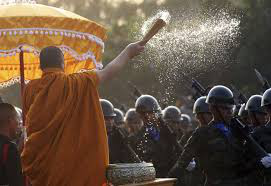
2.) Blessed Water (Nam mon): There is a practice of a Monk lighting a candle to drip wax into a bowl of water while chanting to create “holy water” or “blessed water”. This water is then distributed out onto the body of others around the Monk.
This practice is in conflict with Gotama Buddha’s Teachings and instructions that making of “holy water” is considered a “lowly art”. The Buddha prohibited Monks, including himself, from participating in a practice such as this.
He stated that the Ascetic Gotama refrains from such lowly arts and that a Monk refrains from such lowly arts. There are several lowly arts that are currently practiced by Monks throughout the world that are not in keeping with Gotama Buddha’s original Teachings.
Moreover, Gotama Buddha also taught “the harm of explaining what has not been stated, spoken and prescribed by The Tathāgata as having been stated, spoken and prescribed by him. Those are acting for the unhappiness of many people, for the ruin, they generate much demerit and cause the good Teachings to disappear”.
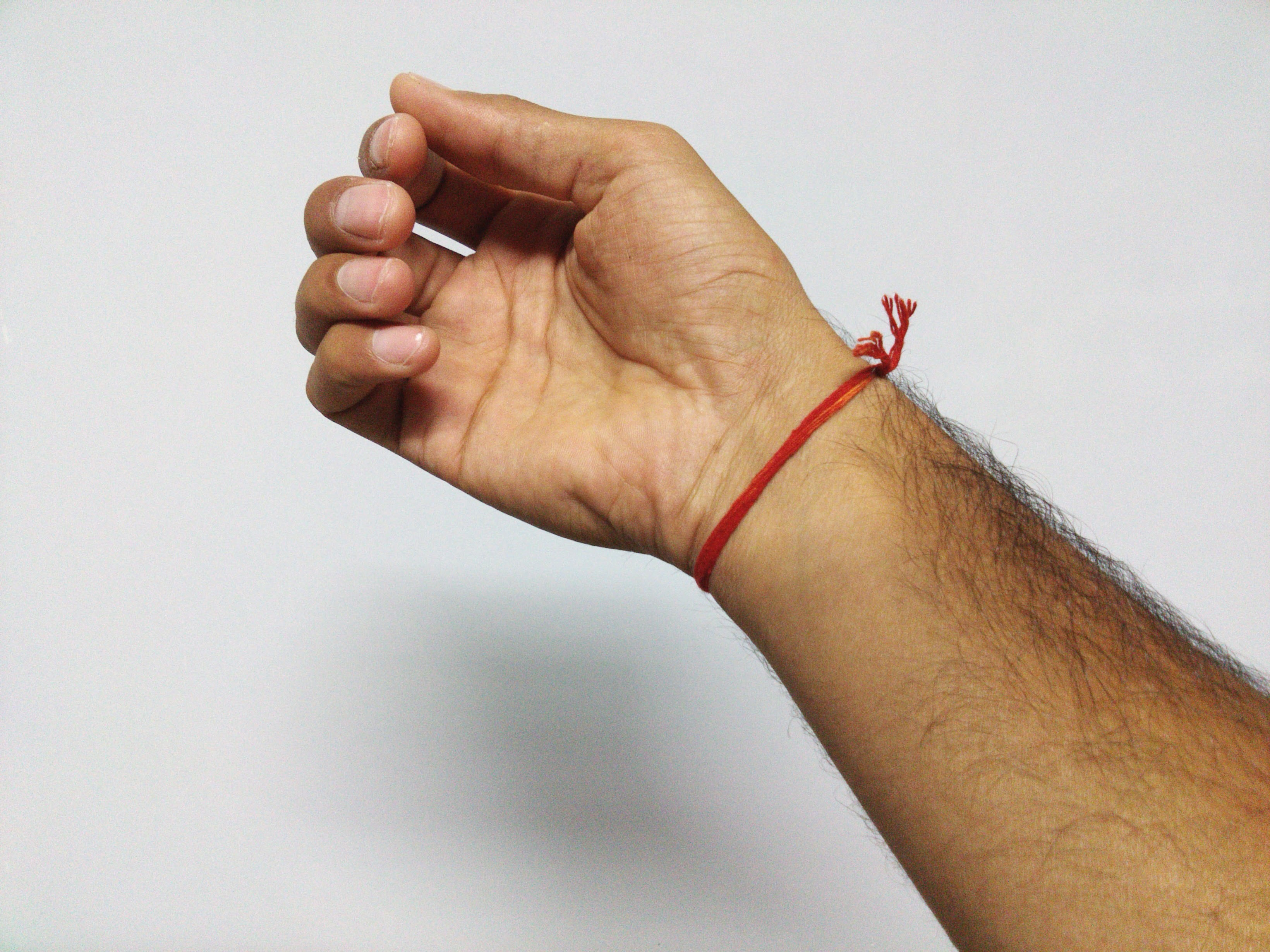
3.) Sacred Thread (Sai sen): The practice of obtaining a sacred thread from an Ordained Practitioner that wraps a body part, oftentimes the wrist, does not originate with Gotama Buddha’s Teachings. Gotama Buddha’s Teachings were offered to liberate the mind through wisdom. He provided Teachings that could be practiced that affect the mind.
385
External objects like sacred thread, bowing to statues, certain body gestures or positioning, ringing bells, hitting gongs, etc., by themselves, do not produce a healthier mental state. These practices alone do not change the condition of the mind if it’s greedy, has hatred, delusion, wrong intentions, wrong speech, or wrong actions, etc.
No matter how many strings or other external objects we look to, they are not capable of producing permanent inner change or peace of mind attained through Enlightenment. There is nothing external that will create lasting inner change or inner fulfillment.
4.) Ordained Practitioners (Bhikkhus and Bhikkhunis): It is important to review the practices of Ordained Practitioners closely. There are past Teachers who have modified and changed Gotama Buddha’s original Teachings that could produce unwholesome practices that lead individuals through a longer path towards Enlightenment or potentially inhibiting Enlightenment altogether.
Teachers after Gotama Buddha have influenced or even modified his Teachings, thus, could be potentially inadvertently affecting one’s path if they were to blindly follow The Teachings of Teachers other than Gotama Buddha.
For example, many Ordained Practitioners follow a practice of not “wai-ing” (showing respect) to Household Practitioners, and Household Practitioners will often get on their knees and bow to Ordained Practitioners.
This practice of not showing respect to Household Practitioners is not described anywhere in Gotama Buddha’s Teachings and could potentially be harmful for the Ordained Practitioners’ development of the mind if they allow “ego” or other unwholesome mental states to develop or exist. Bowing to Ordained Practitioners could produce a mind placing an individual above or below each other with judgment. If the mind is developed in this way, it will inhibit one from attaining Enlightenment.
Ordained Practitioners are human just like everyone else with their own challenges and struggles in pursuing Enlightenment. They have chosen a lifestyle, temporarily or perhaps until death, that provides a discipline that helps create conditions conducive for Enlightenment but does not guarantee Enlightenment. Therefore, Ordained Practitioners will need to pursue their own Enlightenment with the same Teachings and learning as Household Practitioners including “The Three Universal Truths”, “The Four Noble Truths”, and “The Eight Fold Path” along with others.
386
The precepts one chooses to practice is up to the individual and their lifestyle, however, “The Five Precepts” is a baseline minimum that is required for all individuals to attain Enlightenment.
An Ordained Practitioner who does not show respect to another being because they think they are practicing a higher number of precepts could develop a mind of ego and excessive arrogance, pride, or conceit. An Ordained Practitioner who is pursuing Enlightenment should have generosity, loving-kindness, and compassion for all beings without ego. They should not expect people to show them respect just because they have chosen to live a life as an Ordained Practitioner.
Respect should be shown to all beings by all beings.
The ordained path was created by Gotama Buddha to teach a humble lifestyle. He created the ordained path as the lowest and must humble livelihood through giving up of possessions, relationships, jobs, income, and for Ordained Practitioners to enter homelessness.
This lifestyle significantly reduces cravings/desires/attachments through a pre-prescribed discipline taught by Gotama Buddha and should also help to eliminate the ego. The ordained path creates conditions more conducive for Enlightenment but does not guarantee Enlightenment.
All individuals need to continuously and constantly pursue Enlightenment through developing their practice. An Ordained Practitioner should not have “arrogance or pride” in themselves just for being ordained and, therefore, “higher” in society than other beings. This would produce ego. This is exactly the opposite intention of Gotama Buddha in creating The Community of Ordained Practitioners and by not eliminating “conceit” this would inhibit one from attaining Enlightenment.
There are Ordained Practitioners whose practice of these Teachings is not as developed as Household Practitioners. For anyone to have excessive arrogance or pride in themselves for the development of their practice just because they are ordained, is negating the intentions of these Teachings. We must always and forever develop our practice to “eliminate ego” and never “assume” it has been extinguished.
In addition to the “lowly arts” mentioned previously, Gotama Buddha provided guidance that Ordained Practitioners should not provide tattoos, palmistry, cast spells, conduct fortune telling, house blessings and other “lowly arts” as part of their livelihood. Ordained Practitioners should not provide these services and others mentioned in The Teachings, but, instead focus their time on learning, practicing, and sharing these Teachings.
387
Ordained Practitioners should be the deepest Practitioners as leaders to guide others in The Teachings, but, are not always practicing The Teachings as taught by Gotama Buddha.
We should not obtain images or tattoos of Gotama Buddha. This practice can form attachments and would only further inhibit one from attaining Enlightenment.
It is best for all individuals to show respect to all people not placing one’s self above or below another human being.
|
Gain, Honor, and Praise, Are an Obstacle Even For an Arahant Monks, gain, honor, and praise, I say, are an obstacle even for a Monk who is an Arahant, one with taints destroyed. When this was said, the Venerable Ānanda asked the Master Teacher Gotama: ‘Why, Venerable Sir, are gain, honor, and praise an obstacle even for a Monk with taints destroyed?’ I do not say, Ānanda, that gain, honor, and praise are an obstacle to his unshakable liberation of mind. But I say they are an obstacle to (his attainment of) those peaceful dwellings in this very life which are achieved by one who resides diligent, dedicated, and determined. So dreadful, Ānanda, are gain, honor, and praise so bitter, vile, obstructive to achieving the unsurpassed security from bondage (Enlightenment). Therefore, Ānanda, you should train yourselves thus: ‘We will abandon the arisen gain, honor, praise, and we will not let the arisen gain, honor, and praise persist obsessing our mind.' Thus should you train yourselves. (Gotama Buddha) (Reference: SN 17.30) |
|
This Spiritual Life Is Not Lived for the Sake of Deceiving People Monks, this spiritual life is not lived for the sake of deceiving people and persuading them; nor for the benefit of gain, honor, and praise; nor for the benefit of winning in debates; nor with the thought: 'Let the people know me thus.' But rather, this spiritual life is lived for the sake of restraint, abandoning, freedom from strong feelings, and elimination. (Gotama Buddha) (Reference: AN 4.25) |
388
To learn more about what Gotama Buddha taught related to the practices for the Ordained Practitioners, see the book titled “Lowly Arts” (Volume 12) of this same book series.
5.) Chanting or Mantras: Throughout the world there are Practitioners who do “chanting” of The Teachings. It is important that Practitioners understand, while chanting can help to create mindfulness (i.e. awareness of mind), concentration, and memory, the words themselves and the sounds coming from a person’s mouth do not have any mystical, magical, or special power to attain or create Enlightenment.
There are no mystical, magical, or special powers that one could use in a chant or mantra that would create benefit of doing such things as destroying unwholesome Kamma, attaining Enlightenment, transferring Merit/Kamma, achieving a long life, helping beings that have already died, improving one’s destination after death or any other beneficial result.
Mantras are sometimes taught and “believed” to have mystical, magical, or special powers. This is not true and will not result in beneficial outcomes beyond training for concentration, memory, or awareness of mind.
All of Gotama Buddha’s Teachings are focused on the Practitioner learning and practicing Teachings that train the mind, not invoking mystical, magical, or special powers for any sort of benefit. Gotama Buddha himself did not teach these types of practices and described them as a “lowly art”.
Chanting can be relaxing and a powerful practice to calm the mind while developing awareness of mind and awareness of breath through training of the mind, but not through mystical or magical powers.
To attain Enlightenment, a Practitioner needs to practice the entire Eight Fold Path. It is through our practice of learning and applying The Teachings in everyday life, that we liberate the mind to attain Enlightenment.
Listening to chanting or performing chanting can help to create a peaceful mind, develop mindfulness, and awareness of breath. One can use the practice of chanting to improve concentration, memory, and awareness of mind among other beneficial results to train one’s own mind.
Chanting can help calm the mind, however, the Practitioner will need to do the work to sustain the mindfulness and calmness of mind long term.
Chanting is just one practice that helps to develop mindfulness and the mind will need a “life practice” to cultivate a content mind with Enlightenment. A
389
Practitioner will need to learn and practice the entire Eight Fold Path as their “life practice” to attain Enlightenment.
Merely chanting or reciting a mantra for some beneficial result is not what Gotama Buddha taught as part of The Path to Enlightenment. These Teachings are 100% focused on learning and practicing Teachings that lead to liberation of the mind to eliminate discontentedness.
A chant or mantra alone will not accomplish that goal and is not required to attain Enlightenment.
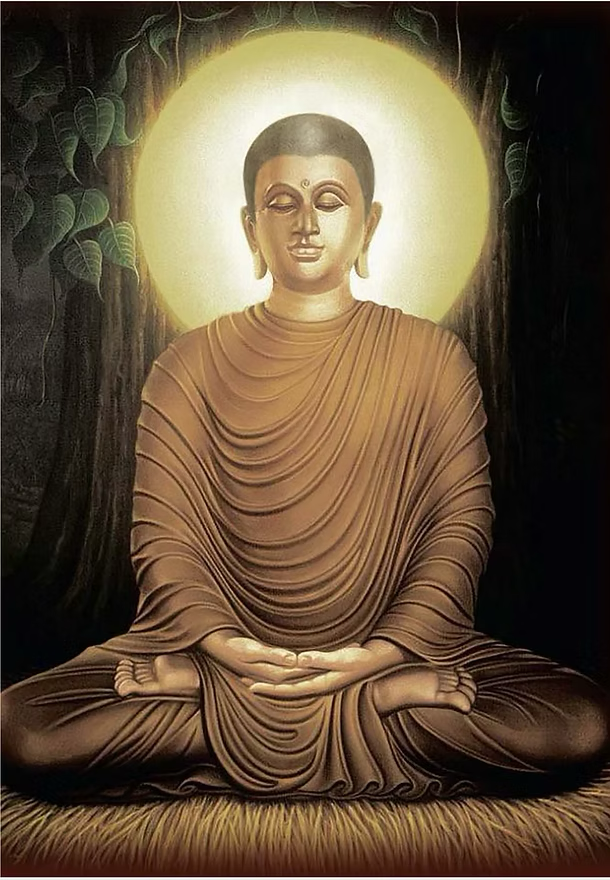
6.) Gotama Buddha Statues: Every statue of Gotama Buddha looks very different depending on what culture has created the statue. China, Tibet, Thailand, Sri Lanka and other cultures all have Buddha statues but they all look different.
What you will notice is that each culture casts statues of Gotama Buddha based on local tradition and local appearances from within the culture that casts the statues. Statues in Thailand look very Thai while Chinese statues look very Chinese, and so forth. None of these statues resemble the description of Gotama Buddha in his Teachings. (See “Image of Gotama Buddha” at the end of this Chapter.)
People cast statues based on their culture’s appearance due to the affection that people have for Gotama Buddha in that each culture would like Gotama Buddha to look as close to them as possible.
It is a form of craving or mental attachment to Gotama Buddha and having a craving or desire for Gotama Buddha to be from the culture that made the statue.
Keep in mind, we should not allow the mind to crave/attach or worship any image or statue of Gotama Buddha. Gotama Buddha taught us to learn and practice his Teachings so that we can attain the results which is Enlightenment. He was not interested in teaching us to attach to his image or worship him as he knew it would lead to discontentedness of mind and not to Enlightenment. Any and all forms of attachment will cause a discontent mind.
Some people believe the spirit of Gotama Buddha resides in the statues and they can be found praying to the statue (i.e. Gotama Buddha’s spirit) asking for benefits. Gotama Buddha never taught to create statues of him or that his spirit resides in any statue. In fact, he never taught whether a spirit or soul exists or does not exist. He left this as an undeclared Teaching.
390
The highest form of respect you can give to a Teacher is to practice their Teachings.
Merely, worshiping Gotama Buddha’s image will not produce Enlightenment, thus, he did not teach us this practice. He only ever taught us Teachings that lead to Enlightenment, and worship of a statue does not produce Enlightenment.
7.) Gotama Buddha as a God, Avatar, or Lord: There are some traditions that consider Gotama Buddha a God or Avatar.
Common definitions of the words “God” or “Avatar” are:
God: the creator of the universe and source of all moral authority; the supreme being.
Avatar: a manifestation of a deity or released soul in bodily form on earth; an incarnated divine Teacher.
Gotama Buddha never described himself as a God or Avatar during his lifetime. He considered himself a human and a Teacher who discovered “The Path” to a better existence. Gotama Buddha is the discoverer, originator, and declarer of “The Path” to Enlightenment. He then humbly taught this path to others as a human being and a Teacher.
Additionally, some people refer to Gotama Buddha as a “Lord” or “Lord Buddha”. The word “Lord” has meaning in communities throughout the world that is very well defined and specific within those communities.
Using the word “Lord”, which Gotama Buddha himself did not use, can be confusing for a Practitioner of these Teachings who has exposure to the word “Lord” within other communities and traditions.
Most commonly, the word “Lord” is used to refer to Jesus Christ as “The Lord”. Because a large majority of the world uses this word to refer to Jesus Christ, it would be very confusing for anyone with this background to understand Gotama Buddha in this same context as Jesus Christ referred to himself as “The Only Lord”.
A common definition of the word “Lord” is:
Lord: someone or something having power, authority, or influence; a master or ruler. (Noun)
Lord: act in a superior and domineering manner toward (someone). (Verb)
391
Synonyms: order about/around, boss about/around, give orders to, domineer, dominate, dictate to, pull rank on, tyrannize, bully, have under one’s thumb, etc.
With close review of the word “Lord”, you can see that the common definition of this word is opposite of what Master Teacher Gotama Buddha taught.
Gotama Buddha taught us to be humble, peaceful, calm, polite, kind, friendly, and respectful. He did not teach us to have “power” or to have a “domineering manner towards someone”. His Teachings and guidance were exactly the opposite of these qualities. If we assign or use the word “Lord” to refer to Gotama Buddha, we are also assigning these qualities to Gotama Buddha which are directly opposite of his Teachings.
We should be careful to not refer to or consider Gotama Buddha as anything other than a human and a Teacher or Master Teacher.
He only ever referred to himself as a human so why would we refer to him as anything other than a human? He was a Teacher, a Fully Perfectly Enlightened Buddha, and he also used the term The Tathāgata.
It is not possible to pray to Gotama Buddha to ask for favors and wishes. He has died and will never return to another rebirth.
It is only through the practice of his Teachings that you will experience a liberated mind through wholesome intentions, speech, and actions along with his other extensively clear and concise Teachings that lead to a better life.
8.) Blessings: There are several phrases related to “blessings” used in current day language with good intention but with misunderstanding of Gotama Buddha’s Teachings.
Phrases you may hear include “May Buddha Bless You”, “May the Triple Gem Bless You” or other variations of these phrases. You may see reference to Gotama Buddha as “The Blessed One”.
A common definition of the word “Bless or Blessing” is:
Blessing: God’s favor and protection; a prayer asking for God’s favor and protection.
392
Gotama Buddha was a human being and a Master Teacher. He taught to abandon and discouraged “rites, rituals, ceremonies, and worship” as he understood they would not lead to Enlightenment. Rites, rituals, ceremonies and worship do not change the condition of the mind.
There was never a time in Gotama Buddha’s Teachings where he discussed that he offered “blessings” or that anything he taught was connected to a “blessing”. He also did not teach people prayer or prayer to him as part of his Teachings. These phrases are misunderstandings of Gotama Buddha’s Teachings. (See the book titled “Generosity” (Volume 13) in this same book series, Chapter 83 titled “Aspirations Are Not Obtained by Means of Prayer” for The Words of The Buddha related to his Teachings on discouraging the use of prayer.)
Gotama Buddha encouraged Practitioners to learn and practice The Teachings he shared so that you can observe the truth in The Teachings improving the condition of the mind. In this way, one acquires wisdom and liberates the mind to attain Enlightenment.
Gotama Buddha cannot bless us and nothing he taught involved a blessing but instead dedication and commitment to learning and practicing The Teachings that lead to Enlightenment.
In places where you see the title “The Blessed One”, I encourage you to replace “The Blessed One” with “The Perfectly Enlightened One” as this more accurately reflects Gotama Buddha’s Teachings.
9.) Buddha, Buddhahood, or Buddha Nature: Some traditions of these Teachings consider all people to be a Buddha and when you attain Enlightenment, you are a Buddha. This is not what Gotama Buddha taught.
Gotama Buddha was often referred to as “Ascetic Gotama” during his lifetime. Prior to giving up his royal heritage, he was known as Siddhartha Gotama. Upon leaving the royal palace to seek a better understanding of life through attaining Enlightenment, he was known as “Ascetic Gotama” or in other words “Monk Gotama”. Some people referred to him as Teacher or Master Teacher Gotama.
He would most often refer to himself as “The Tathāgata”.
The term Tathāgata is often thought to mean “one who has discovered the truth”, “one who shares the truth”, “one who has thus gone”, or “one who has thus come”. This is understood as signifying that The Tathāgata is beyond all coming and going - sharing the truth of The Natural Laws of
393
Existence that lead to Enlightenment. There are, however, other interpretations, and the precise original meaning of the word is not certain.
Gotama Buddha is quoted on numerous occasions in The Pāli Canon (the source of his Teachings) as referring to himself as “The Tathāgata” instead of using the pronouns me, I, or myself. This may be meant to emphasize by implication that The Teaching is spoken by one who has transcended the human condition, one beyond the otherwise endless Cycle of Rebirth and death (i.e. beyond discontentedness of mind).
The term Tathāgata has a number of possible meanings.
Gotama Buddha understood the use of the pronouns, me, I, or myself is unfitting to refer to the human condition as there is “no self”, as explained in the previous chapter titled “The Four Noble Truths: Establishing Right View” and “Dissolving the Ego: Ego Serves No Purpose” on The Teaching of “non- self”. The term Tathāgata is a way to refer to himself without using the pronouns me, I, or myself.
Other meanings for the term Tathāgata include:
- He who has arrived in such a fashion, (i.e. who has worked his way upwards to perfection for the world’s good).
- He who by the path of knowledge has come at the real understanding of things.
- He who has won Truth.
- He who has discerned Truth.
- He who declares Truth.
Regardless of what the term Tathāgata means or whether you refer to Gotama Buddha as a Teacher or Master Teacher, he rarely, if ever, even referred to himself as a Buddha and he never referred to people who attained Enlightenment as a Buddha.
So, the man we appreciate, respect, and have admiration for because he shared his Teachings with the world to fully liberate the mind to attain the mental state of Enlightenment rarely, if ever, even refer to himself as a Buddha and never referred to another person who had attained Enlightenment during his lifetime as a Buddha.
The use of the term Buddha to refer to Ascetic Gotama or Monk Gotama was mostly applied to him after his death in 483 BCE. It was after his death that people widely referred to him as a Buddha.
394
Master Teacher Gotama Buddha never referred to people who attained Enlightenment as a Buddha. He did not refer to Enlightenment as Buddhahood. He did not teach that people have Buddha Nature. He did not tell people they are potentially a Buddha. He rarely, if ever, even referred to himself as a Buddha and all these uses of the title Buddha referring to a person who has attained Enlightenment is not what Gotama Buddha taught.
You will not find these Teachings and use of the term Buddha for an Enlightened being in the source of his Teachings within The Pāli Canon because Gotama Buddha did not teach that everyone is a Buddha, that one would attain Buddhahood, or use the term Buddha Nature to refer to Enlightenment. A person who has attained Enlightenment at the highest stage with the guidance of Teachers would be referred to as an Arahant or perhaps an Enlightened person or an Enlightened being.
Because Gotama Buddha did not teach in this way to use the title Buddha, the title Buddha should not be used to refer to someone who has attained Enlightenment (i.e. is Enlightened) but one could be considered an Arahant.
Gotama Buddha left his royal palace, attained Enlightenment on his own through a 6-year pursuit of hard work and dedication bringing him close to death, taught countless people how to attain Enlightenment during his lifetime, left Teachings that would help countless people after his death to attain Enlightenment, established the ordained path for individuals to attain Enlightenment as Ascetics which is still alive today, and most importantly he was the deepest Practitioner ever known to humankind of The Teachings he shared. He was the discoverer, originator, and declarer of The Path to Enlightenment.
There is no one that has come after Gotama Buddha or will come after Gotama Buddha that has had the same dedication and commitment to sharing The Teachings that lead to Enlightenment as Gotama Buddha did - a true Buddha. There is no one that has or will have as much of an impact to benefit all of humanity in the same way as Gotama Buddha, a true Buddha, including the expected appearance of the next Buddha Maitreya.
To refer to another human who has merely attained Enlightenment as a Buddha, as attained Buddhahood, or having Buddha Nature is to disrespect and minimize the hard work and effort our Master Teacher Gotama Buddha exhibited during his 45-years of Teaching, whose Teachings have drastically improved the existence of countless human beings over the past 2,500 years, and will continue to have an impact well into the future of humanity.
If someone refers to themselves as a Buddha, having attained Buddhahood, or having Buddha Nature is to place themselves on the same level as the
395
individual who is admired and respected across the entire world for a lifetime of dedication and service to others, whose Teachings have stood the test of time even now, over 2,500 years later. Gotama Buddha was a true and real Buddha.
You are not a Buddha and will never be a Buddha. You will not attain Buddhahood. You do not have Buddha Nature. You can attain Enlightenment as an Enlightened being considered an Arahant but your work and effort will never amount to the impact shared in the world as that of a true Buddha who attains Enlightenment through their own independent journey and then, guides countless other beings to attain Enlightenment.
Referring to oneself as a Buddha, having attained Buddhahood, or having Buddha Nature is to do so with ego and, therefore, it is widely known an individual who does so is not even Enlightened.
If one has ego placing themselves on the same level as Gotama Buddha, a true Buddha, they still have ego and cannot have even attained Enlightenment.
To attain Enlightenment, one needs to dissolve the ego. If someone refers to themselves as a Buddha, having attained Buddhahood, or having Buddha Nature, the ego is still present and has not yet been dissolved. Therefore, you can consider that a person who claims to be a Buddha, having attained Buddhahood, or has Buddha Nature that they are not yet even Enlightened, and lack the appreciation, respect, and admiration as exists for the man once known as Siddhartha Gotama, Ascetic Gotama, Monk Gotama, Teacher Gotama, Master Teacher Gotama, or The Tathāgata.
Gotama Buddha rarely, if ever, referred to himself as a Buddha, why would anyone else refer to themselves as a Buddha unless there is craving/desire and ego while seeking admiration by putting themselves on the same level as Gotama Buddha. If there is craving/desire or ego, one cannot even be Enlightened so how could they be a Buddha?
The Chapter titled “Enlightenment: What is Enlightenment?”, shared previously in this book, has many characteristics of what is a true and real Buddha. To be considered a Buddha, one would need to meet those criteria.
396
|
The Rare Appearance of Five Treasures Licchavis, the appearance of five treasures is rare in the world. What five? (1) The appearance of a Tathāgata, an Arahant, a Perfectly Enlightened One is rare in the world. (2) A person who can teach The Teachings and discipline proclaimed by a Tathāgata is rare in the world. (3) When The Teachings and discipline proclaimed by a Tathāgata has been taught, a person who can understand it is rare in the world. (4) When The Teachings and discipline proclaimed by a Tathāgata has been taught, a person who can understand it and practice in accordance with The Teachings is rare in the world. (5) A grateful and thankful person is rare in the world. Licchavis, the appearance of these five treasures is rare in the world. (Gotama Buddha) (Reference: AN 5.195) |
397