Chapter 11
Meditation:
Developing Your Practice
Gotama Buddha said, “meditate or lest you regret it later”. We have this extremely rare human existence and we should not let it go to waste through laziness, complacency or excessive delays. We should utilize our time in this human form to develop and cultivate a pure mind so that we can experience a peaceful and content life while escaping The Cycle of Rebirth.
Gotama Buddha explained that “a pot without a stand is easy to tip over”. The mind is the “pot” and your meditation practice is the “stand”. Without a stable “stand” (i.e. meditation practice) the pot (i.e. the mind) is going to constantly be “tipped over”.
The reason why the mind keeps experiencing discontent feelings such as sadness, anger, frustration, irritation, annoyance, guilt, shame, fears, boredom, loneliness, shyness, jealousy, resentment, stress, anxiety, etc. is because there is not a well established meditation practice along with learning and practicing the entire Path to Enlightenment. The mind keeps getting “tipped over” experiencing discontent feelings.
The mind needs a steady and consistent “stand” that you establish through the continual development of your meditation practice to train the mind. With a stable meditation practice, a Practitioner can develop mental discipline and the mind won't keep getting tipped over to experience discontent feelings.
Developing a solid and consistent meditation practice that provides the mind training and development is an essential part of learning and practicing these Teachings. The mind needs a steady and consistent “stand” that you establish through the continual development of your meditation practice to train the mind.
Meditation is a technique to actively train the mind during dedicated, independent, purposeful training sessions to eliminate unwholesome qualities of the mind and/or cultivate wholesome qualities of the mind in the positions of seated, lying, standing, or walking.
221
Just as important as it is to understand what meditation is, it is just as important to understand what meditation is not. Meditation is not exercising, walking the dog, gardening, driving, watching a sunset, dancing, listening to music, martial arts, nature watching, etc. These are activities that are beneficial to one’s life through experiencing various aspects of life but these are not active, dedicated, independent, purposeful training sessions to eliminate and/or cultivate various qualities of the mind.
Meditation is the foundation of our “life practice” that trains the mind. Over time and with a well developed life practice that includes meditation, you will discover the same truths as Gotama Buddha and acquire wisdom. It is the wisdom you develop within a life practice and meditation that liberates the mind. Meditation is the core method of training the mind and establishes a foundation in which to build all the other Teachings and practices taught by Gotama Buddha that lead to Enlightenment.
To attain Enlightenment, an individual needs to focus on developing a practice of Breathing Mindfulness Meditation and Loving-kindness Meditation. These two meditations are required to attain Enlightenment. The other meditations discussed in this Chapter are optional, specialized meditations to be utilized when appropriate and with guidance from a Teacher. All these Teachings and the meditation techniques shared in this book should be learned with guidance of Teachers as one will need assistance on The Path.
Meditation Teacher
It is important for you to find Teachers and guides that will help you along this path. You cannot attain Enlightenment alone or without Teachers. You will need guidance and instruction from people familiar with The Path to Enlightenment.
Only a Buddha, which is extremely rare, would be able to attain Enlightenment without Teachers or guides. The last Buddha existed over 2,500 years ago and the world is currently unaware of the existence of any other Buddha since his existence. Since you are not a Buddha, find helpful Teachers and guides to assist you along this path.
You can find ordained and unordained Practitioners that will provide you guidance in these Teachings and in your meditation practice. It is important to seek guidance from Teachers and guides who have attained Enlightenment as they will be very familiar with this pursuit and be able to best guide you.
222
If a Teacher has abandoned craving, anger, and ignorance (unknowing of true reality) dissolved the ego and realized non-self, they will be most helpful. A Teacher should have a mind with generosity, loving-kindness, and compassion for all beings. You should be able to observe a quiet stillness and calmness in their intentions, speech, and actions.
A Teacher who has attained Enlightenment will be able to explain what Enlightenment is and provide extensive details of what Enlightenment is, is not, and how to pursue Enlightenment. A Teacher will assist you along the path without any self interest, but only to help you attain Enlightenment.
Just like everything else, it is important not to become attached to any one Teacher and learn from multiple people. However, starting off with one Teacher for several years to establish a solid practice can be helpful in getting started. Then, you may find it helpful to seek guidance from other Teachers.
Do not allow someone to instruct you into a very rigid meditation posture that does not feel comfortable for you. If a Teacher is providing very specific and rigid positioning for the body that is not comfortable for you, the body positioning being taught may work for that Teacher but may not work for you. It is important that you are not “attached” to do meditation in the exact same body position as a Teacher because what works for one person may not work for another. The goal of meditation is to train the mind not the body.
Gotama Buddha never gave us exact parameters for meditation positioning of the body but instead offered four (4) positions to be used. He realized that everyone is unique and different so the exact position you use could be different than another person and will change over time. Meditation and these practices are not about everyone doing meditation exactly the same way. That is impossible because of The Universal Truth of Impermanence.
A helpful meditation Teacher will work with you to find a position that works best for you within these four (4) postures, not force you to follow what works for them. If someone is forcing you to follow their methods, that means they are attached to their methods and, thus, are not fully practicing The Teachings of non-attachment and are not understanding impermanence.
It is important that you find what works best for you, then do not become attached to it. As you age or have other physical challenges with the body, your meditation position will need to change. Remember, do not expect permanence including the position that you meditate in. Do not allow someone to instruct you into rigid meditation positions that work for them but do not work for you.
223
You will need to establish a meditation practice that consists of needing only the body, the mind, and the breath without any other attachments like external stimulus. Having the assistance of Teachers and guides is the best way to develop a meditation practice.
If the positioning of the body is uncomfortable and all you feel is pain during meditation, then all the mind will experience is pain. You will be unable to train the mind to be content. So, find positions that are comfortable but not luxurious and be open to make adjustments and changes as the body needs change during meditation or during subsequent meditation sessions. Find the body positions that are most comfortable but not luxurious as you may have a tendency for the mind to drift to luxurious thoughts.
You may find multiple day meditation retreats, retreat centers, and meditation centers helpful to share Teachings and guidance with you while providing you the opportunity to meditate for several days continuously in an environment that is supportive and knowledgable of your pursuit to Enlightenment.
Would you attempt to learn to build a house to dwell and reside without a Teacher? Would you be able to build this house easily and feel safe to reside there? “No, you would not.”
The pursuit to Enlightenment is building a house within the mind for it to reside. You will need help to learn how to develop this mental state.
You are individually responsible for your own journey, but you cannot walk alone. You need guidance to walk The Path to Enlightenment.
You can find Teachers and guidance at: BuddhaDailyWisdom.com.
It is a common practice for Teachers to accept donations for their work to help you in developing your practice. By offering donations to your Teachers, you are practicing generosity, which helps you to practice non-greed and eliminate attachment to money, while also showing your appreciation to those that help you on The Path to Enlightenment. It is only because of Students before you that donated support that has allowed these Teachings to continue to present day where you are now able to learn these Teachings to benefit your life. Others donated support to help preserve these Teachings for you and you should look for ways to provide support to help those yet to come.
Teachers typically give their time, effort, and wisdom to help others through their teaching and oftentimes live a basic life with only the basic needs to sustain life. Food, water, clothing, shelter, and medical care is all that is truly
224
needed for existence and Teachers who practice these Teachings closely will be pleased to help you regardless if you make donations or not.
To show your appreciation and to support the continued learning and sharing, your offerings of donations will assist your Teachers to continue to share The Teachings with you and others.
You do not need to wait to be asked to offer a donation, as most Teachers will never ask a Student for money or support. You can independently on your own, share with your Teachers that you would like to provide them support and offer donations as you feel appropriate.
225
|
One Who Points Out Treasure Ānanda, I shall not treat you as the potter treats the raw damp clay. Repeatedly restraining you, I shall speak to you, Ānanda. Repeatedly guiding you of what to avoid, I shall speak to you, Ānanda. The truly dedicated will stand [the test]. Regard him as one who points out treasure, the wise one who seeing your faults guides you of what to avoid. Stay with this sort of Teacher. For the one who stays with a Teacher of this sort, things get better, not worse. (Gotama Buddha) (Reference: MN 122 & DHP 76-77) Author’s Thoughts: In order to share The Teachings that lead to Enlightenment, a Buddha or any Teacher, would need to help Students uncover unwholesome qualities in the mind and in their life practice while pointing out the cultivation of wholesome qualities. A Student will need to put their trust in the Teacher while investigating the areas of improvement the Teacher identifies and shares with the Student. A Student will need to be inviting and accepting of a Teacher’s guidance in order to identify areas of improvement and then learn, reflect, and practice Teachings to improve their life practice. If a Student allows the ego to block the guidance from the Teacher while feeling displeasure in the Teacher “pointing out treasure”, they will not “stand the test” of receiving guidance from the Teacher to progress towards Enlightenment. A Teacher would need to exert a significant amount of time, effort, energy, and resources to guide a Student to Enlightenment. A Teacher should not ask for any benefits from their Students, but instead, await what is given as offerings. A Teacher’s only goal should be to guide a Student to Enlightenment without any personal gain for themselves whatsoever. So, a Teacher who takes their time, effort, energy, and resources to “point out treasure” should be regarded as a “wise one who seeing your faults” will help you to learn, reflect, and practice The Teachings to attain Enlightenment. The Buddha’s advice is to “stay with this sort of Teacher” as things only “get better, not worse”. As the condition of the mind and one’s life, “only gets better, not worse” when a Student is open to understanding guidance from a wise Teacher who kindly and patiently shares areas for improvement while not seeking any benefit from you - their only goal is to help you. In this type of relationship with a wise Teacher pointing out areas of improvement as treasure to be appreciated based on the goal of helping you, you should “stay with this sort of Teacher” as things only “get better, not worse”. |
226
Gotama Buddha provided us four (4) positions to meditate. Seated, lying, standing, and walking are the four (4) positions of meditation. These positions can be used at different times, interchangeably, for different purposes and best learned with Teachers. Through you learning and practicing these body positions, you can decide what is or is not working for you in any given situation. It is only when you learn and apply The Teachings in practice that you will know the truth of what is and is not working for you. Then, seek guidance from a Teacher to better help you gain insight into the development of your meditation practice.
Seated Position
It is common to start with learning meditation in the seated position.
Lower Body
You can sit on the floor, in a chair, on a bench, a wheel chair, or other location. The important thing is that the lower body is supported and comfortable. If all you feel is pain from sitting on the floor, this is not the right position for you to meditate at this time.
You can work to develop sitting on the floor if you like, however, if all you experience is pain then you will find it difficult to observe anything else in the mind other than pain. So, find a seated position that is comfortable for you.
The position should be comfortable but not luxurious.
Upper Body
The upper body should be fully supported by your own strength. You should not slouch or be too stiff and upright. Maintain a comfortable and supported upper body that is in the “middle" and allows for comfortable, steady, and consistent breath.
If you choose to meditate in a chair, try not to lean back using the back rest unless it is required to eliminate pain or the back muscles are insufficient to support the body. Try using the back muscles to support your upper body, if possible, to maintain an attentive and alert mind.
227
Hands and Arms
The hands and arms should be relaxed in front of you. There are several different ways to place the hands and arms. You can see the below photo to observe how Gotama Buddha performed meditation.
Gotama Buddha placed his right hand on top of his left hand with the thumbs touching together. If this works for you, you can use this technique.
Other options include placing the palms of your hands on your lap or on top of your knees.
You should not be attached to placing the hands and arms, or other parts of the body, in the exact same position as Gotama Buddha. However, if they work for you then you can use those.
The most important thing is that the hands and arms are relaxed in front of the body and comfortable. There are many ways to accomplish this goal.
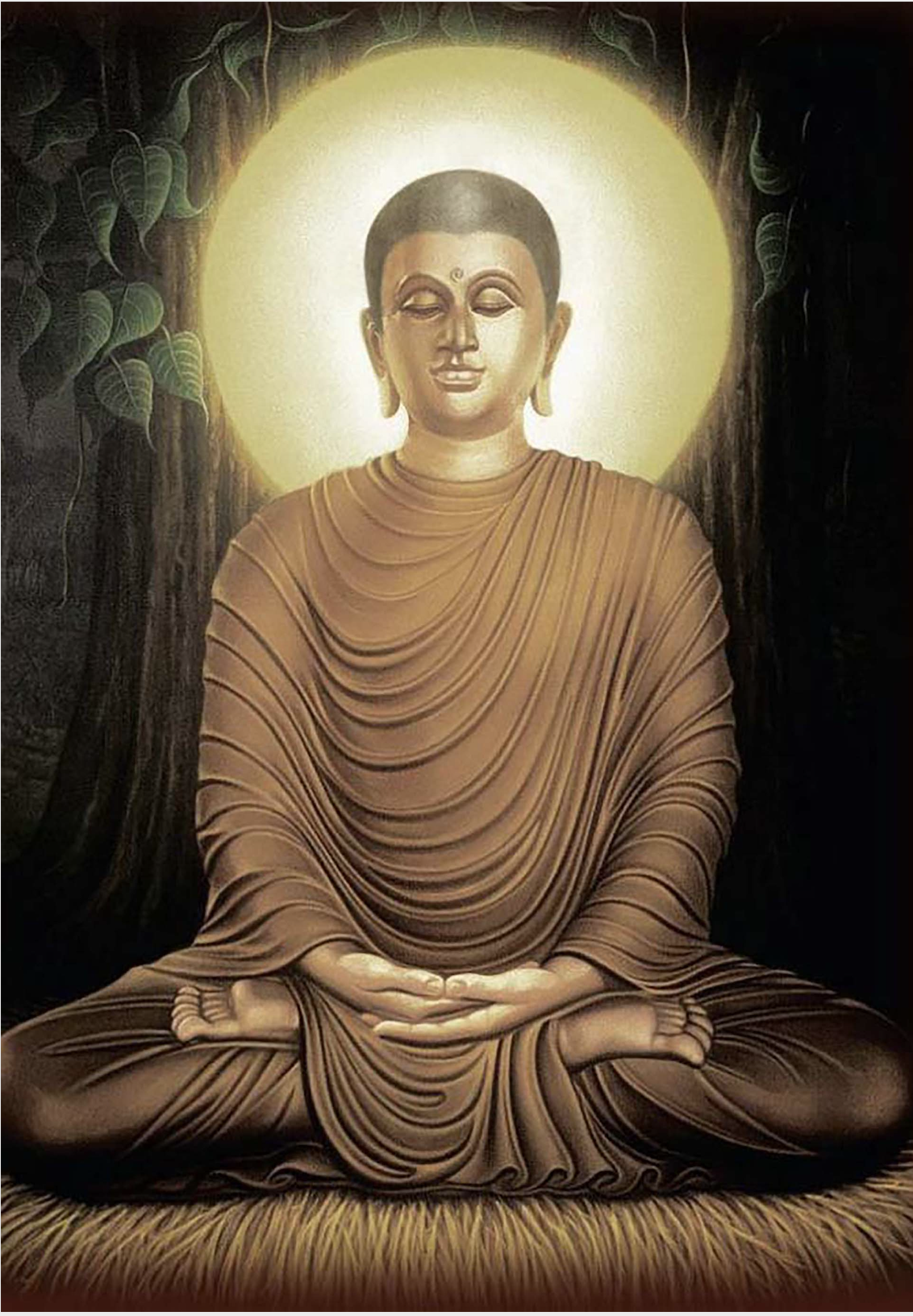
Remember, one aspect of this practice is to eliminate ego. So, it is not important that we all force ourselves into the same body position or emulate Gotama Buddha’s meditation posture to determine who is doing it “right” or “wrong” or who is better than another.
The “right” position for you is the right position for you. And, this will change over time as the body needs to be adjusted as the body has physical changes over the course of your lifetime. You may start meditating on the floor but later in life, move to a chair or other position.
228
What is important, is that you find a comfortable position that allows the body to be seated comfortably while you train the mind, then, not be attached to that position as it will not be permanent and will need to change over time.
Lying Position
Lying position can be used for various reasons. If you are using seated position for long periods of time and would like to change positions to continue your meditation, you may choose to switch to the lying position. If the body is tired and you are interested to relax all the muscles in the body while meditating, this could be a helpful position for you.
If you are interested to train the mind not to be attached to the seated position, lying position is another option.
You may also need lying position at times when other positions are not possible. If you are sick or otherwise incapable of sitting, standing or walking, meditation in the lying position is an option for you.
You can lay on the floor, a bed, or any other location. If you are able to lay on the floor, this is a good place to start while also being open to meditating in a bed. If you are in the hospital or otherwise confined to a bed, it is nice to have the lying position available for you to meditate.
All the muscles in the body should be relaxed and comfortable. Be sure you maintain the mind in meditation as a lying position may promote a sluggish or sleepy mind. Remember, meditation is to train the mind so if you are falling asleep while trying to meditate, it will limit your ability to train the mind. To train the mind you will need to maintain an attentive and alert mind.
Conversely, if you are having trouble falling asleep, you could use the lying position and meditation to assist you in falling asleep. Be sure you also have meditation sessions where you are training the mind to eliminate or cultivate the mental qualities discussed in this book. This includes training the mind as described in the various meditations shared in this Chapter.
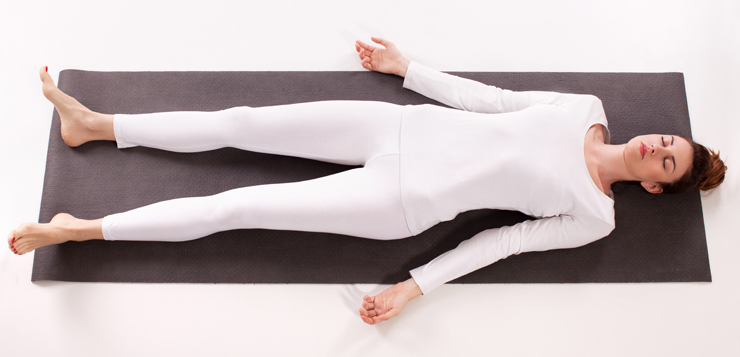
The below photo demonstrates a potential option for lying position. Again, you will need to work with the body and Teachers to help you find a lying position that works for you and then you should not be attached to that position as it will need to change.
229
Standing Position
Just like lying position, standing position provides another option for meditation and can also be used at different times for various purposes. In the same way as lying position, standing can be used when you would like to change positions to continue your meditation or when another position is not possible.
You may use standing position during a dedicated meditation session when the body needs to change positions. You can also use standing position while standing at a bus stop, in line or another location where you are standing and would like to do a bit of meditation.
For standing position, you stand upright with both feet together and your arms in front of you using one hand to clasp the wrist on the opposite side of the body. There is no secret with which hand clasps the other. It’s up to you.
If clasping at the wrist with one hand is not possible, then you could allow the arms to just relax at your side or clasp them at the wrist behind the body. Again, no attachments to a specific posture, the body needs to be comfortable but not luxurious.
Walking Position
Walking position is another position for meditation that can be used and can be helpful. If the mind is very active and unwilling to sit, lay, or stand, walking position could be used. Additionally, walking position could be used to provide another option that allows you to extend your meditation session to maintain the body in a comfortable position and attentive posture. If the body becomes uncomfortable with one of the other positions, walking position could be used to extend meditation sessions allowing the body to be comfortable.
230
Walking position, as with all meditation, is helpful to learn with a Teacher. You will need to learn various details and instruction should be sought for this position of meditation along with all the others.
All of the following meditation techniques can be conducted in the above mentioned positions.
Breathing Mindfulness Meditation
Breathing Mindfulness Meditation helps you to eliminate craving by training the mind to “cut off thoughts” during meditation, thus, removing the poison of “Craving” or “Greed” while developing the skill of mindfulness.
The goal of Breathing Mindfulness Meditation is to develop “Right Concentration”, “Right Mindfulness”, and to eliminate the unwholesome root of craving by training the mind not to cling or attach to emotions, situations, fears, relationships, the past nor the future expectations you have of yourself. Gotama Buddha explained this as “cutting off thoughts”. You may also think of this as “letting go of the thoughts”.
All discontentedness is from cravings, desires, and attachments so it is important to train the mind to not have attachment.
Developing a mind that has been trained not to have attachments is highly useful in everyday life so that you can more easily let go of your current attachments and not pick up new attachments which will eliminate your discontentedness of the mind.
The benefit of Breathing Mindfulness Meditation is that we develop a calm, steady, peaceful, more concentrated mind through the elimination of cravings/desires/attachments. You can develop an unshakable mind. The elimination of attachments is what creates the concentration and contentedness, not actually the meditation by itself.
This meditation trains the mind not to have craving, then, you will need to practice non-craving and the other Teachings to develop the mind into a pure mind with Enlightenment. It is through a practice of non-craving that the mind will be calm, content, and peaceful to ultimately attain Enlightenment.
Breathing Mindfulness Meditation becomes a way to empty out the mind of past thoughts and future expectations along with any emotions, thoughts, ideas, perceptions, fears, etc. while training the mind to not crave anything because we know craving causes discontentedness. You are training the mind in meditation to not crave so it will be content which produces a calm, stable, and concentrated mind.
231
Breathing Mindfulness Meditation is the foundation of a practice in these Teachings and should be developed as the primary meditation practiced daily.
Cutting off thoughts does not mean you will never have thoughts or it would not be helpful to have thoughts. It means, that you train the mind not to hold on to thoughts, ideas, and perceptions, etc. because then you would be attached to those things. If you are attached to thoughts, ideas, perceptions, etc. then you will “cause yourself” discontentedness when these are not fulfilled as expected.
You will always have thoughts, ideas, wisdom, even memories of past events or goals in the future you’d like to achieve. But when you are attached to these things, then it causes the mind to be discontent. You are causing the mind to be discontent through your own attachments to these thoughts, ideas, perceptions, or the past and future.
You can train the mind to not attach to thoughts but to use them to your benefit without attachment.
It is best to recognize the impermanent nature of all conditioned things, live in the moment, and be “satisfied with what is” with a content mind. Breathing Mindfulness Meditation helps to train the mind to be content with nothing, emptiness, and while being alone doing nothing.
When the mind can be content with nothing, emptiness, and alone during meditation, then this helps to train the mind towards being content in any and all situations. There is more training of the mind that is needed beyond meditation alone, however, many people have challenges to be content while alone due to arising thoughts and emotions from the mind.
Breathing Mindfulness Meditation is a way for you to allow these thoughts to arise, not attach to them and empty them out, while living in the present moment peaceful, calm, and content.
Thoughts and emotions generated by the mind should not bother you or cause the mind to be discontent but this requires training. Sitting alone, breathing, without any bodily action in meditation can allow the thoughts and emotions to arise so that you train the mind not to attach to what the mind produces.
232
By not attaching to what the mind produces, the mind can be peaceful, calm, and content. Slowly over time, the mind will produce less and less negative thoughts or emotions and the mind can cultivate more wholesome qualities and positive mental states during meditation and in daily life.
Breathing Mindfulness Meditation is the practice for you to train the mind to not attach to thoughts, ideas, and perceptions or past events and future expectations, to be accepting and “satisfied with what is”, living in the present moment.
Breathing Mindfulness Meditation is training the mind to “let go” with ease. Over repeated sessions, the mind develops the ability to easily observe an arising thought, idea, emotion, or feeling and then to “let it go”. As the mind develops this ability more deeply, a Practitioner is then able to use this skill in daily life. In daily life when the mind observes an arising unwholesome thought, idea, emotion, or feeling, the mind can then easily “let it go”.
The mind’s ability to consistently observe arising unwholesome mental activity and then easily let it go, will ultimately be what eliminates craving/ desire/attachment and the associated discontentedness.
The mind becomes an expert at “cutting off” unwholesome mental activity and then eventually, these destructive thoughts, ideas, emotions, and feelings will not even arise. But, this is only accomplished through a well developed practice of Breathing Mindfulness Meditation to cultivate awareness of mind (Right Mindfulness) of unwholesome mental activity and then easily “cut it off”. The mind will eventually get tired of clinging to thoughts because of the repeated action of “cutting them off and letting them go”, and eventually submits residing in the middle permanently. The mind gradually learns that every time it has a craving/desire/attachment and discontentedness is produced, a Practitioner “cuts it off” and “lets it go”. The mind slowly discovers that it is unbeneficial and unfruitful to have mental longing with a strong eagerness, thus, it will eliminate this activity in the mind residing completely peaceful and content.
When the mind eliminates mental longing with a strong eagerness (craving/ desire/attachment), it will no longer experience any discontent feelings whatsoever.
A Practitioner will never eliminate thoughts during meditation, even when the mind is Enlightened but instead, through a well developed Breathing Mindfulness Meditation practice, the mind will be quieted and stilled during meditation. Rather than experiencing a bombardment of thoughts, over time, a well trained mind will experience a slowing down of the thoughts where there are long gaps between thoughts. The mind will be quieted and stilled
233
to the point where there are only some occasional thoughts, the mind will be aware of the thought, and be able to then easily let it go coming back to the breath.
|
One Who Perceives Non-Self Eradicates the Conceit ‘I Am’ When, Monks, a Monk has wholesome friends, wholesome companions, wholesome comrades, it can be predicted of him that he will be virtuous (practicing moral conduct), one who resides restrained by the training guidelines possessed of wholesome conduct and resolving difficult situations, seeing danger in small faults. Having undertaken the training guidelines, will train in them. When a Monk has wholesome friends, wholesome companions, wholesome comrades, it can be predicted of him that he will get to hear at will, without trouble or difficulty, talk concerned with the holy life that is conducive to opening up the heart, that is, talk on elimination of desires, on contentment, on solitude, on not getting bound up (with others), on arousing energy, on virtuous behavior, on concentration, on wisdom, on liberation, on the wisdom and vision of liberation. When a Monk has wholesome friends, wholesome companions, wholesome comrades, it can be predicted of him that he will arouse energy for abandoning unwholesome qualities and acquiring wholesome qualities; he is strong, firm in effort, not casting off the duty of cultivating wholesome qualities. When a Monk has wholesome friends, wholesome companions, wholesome comrades, it can be predicted of him that he will be wise, possessing the wisdom that discerns arising and passing away, which is noble and penetrative and leads to the complete destruction of discontentedness. Having based himself on these five things, the Monk should develop further (another) four things. (1) (The perception of) unattractiveness of the body should be developed to abandon lust. (2) Loving-kindness should be developed to abandon ill will. (3) Mindfulness of Breathing (Breathing Mindfulness Meditation) should be developed to cut off thoughts. (4) The perception of impermanence should be developed to eradicate the conceit 'I am.' When one perceives impermanence, the perception of non-self is stabilized. One who perceives non-self eradicates the conceit 'I am, (which is) Nibbāna (Enlightenment) in this very life. (Gotama Buddha) (Reference: AN 9.1) |
234
Breathing Mindfulness Meditation - Starting Meditation
Choose a position of either seated, lying, or standing. Get comfortable, as previously described for the position you choose. Use your breath as an anchor and close the eyes. Through normal breathing in through the nose and out through the nose, the mind can become aware of the breath.
You will need to establish a natural, steady, and consistent breath. The breath should not be rapid or forced. With full awareness of the breath, you can develop a natural, steady, and consistent breath in through the nose and out through the nose. The inhale and exhale should be gradual fully experiencing the entire breath.
If you experience challenges with breathing in and out of the nose, you may consider using a saline rinse to regularly flush out the nose clearing it for a more calming and clearer inhale and exhale.
Allow the breath, and the sound of the breath entering the body through the nose, to become the anchor that brings the mind into the present moment. The mind should be fixed on the sound of the breath or the sensation of the breath moving over the skin of the body into the nose.
The breath is the present moment.
In this way, as you focus on the breath and not the thoughts, you “cut off thoughts”. Bring the mind to the breath entering the nose as the anchor or fixed position of the mind. As any thought enters the mind, you should not observe the thought, attempt to figure it out, evaluate it in any way, or why it’s coming to the mind. Bring the mind back to the breath even if the mind wanders for some time, catch the mind and bring it back to the anchor of the breath.
It may take time for you to establish this practice and, thus, realize the benefits. Immediate benefits do not always happen in just one session.
Remember, Gotama Buddha gave us Teachings that we need to “strive” to implement and attain the results. Gotama Buddha’s Teachings are not lessons you can implement in just 5 minutes experiencing immediate results. You will need to work with these Teachings and gradually implement them into your practice to gradually have a positive impact on the mind over a consistent period of time.
Training the mind to do this in meditation, will help you be able to also “cut off thoughts” in daily life as you need to detach from thoughts, emotions, or situations to attain a content mind. Train the mind in this way through
235
meditation so that the mind has this same training for everyday life. If you train the mind, then you will be able to control the mind through “cutting off” unwholesome mental activity as an application of Right Effort.
Breathing Mindfulness Meditation allows you to train the mind to reside in the present moment using the breath as an anchor. We do not attach to the thoughts or feelings in the mind. We do not analyze what is in the mind during meditation. We just let everything go, by emptying out the mind.
In this way, we train the mind “not to crave” and “not to cling”. By training the mind not to crave during many sessions of meditation, we then have the training to not crave in daily life. We practice “non-craving” always and continuously every day and all day. Craving is the “cause” or “origin” of all our discontentedness and suffering it causes.
We cause our own discontentedness. We eliminate it by not craving. Breathing Mindfulness Meditation is the practice that trains the mind not to crave. With regular daily sessions of training, you will then be able to control the mind in all situations as you near closer to Enlightenment.
Breathing Mindfulness Meditation is a practice to train the mind but it also, like everything else in your life, has an effect on your Kamma. Through being still, calm, and peaceful for extended periods of time, you are producing only wholesome Kamma. This means, for whatever period of time you conduct meditation, you are practicing the entire Eight Fold Path, thus, you eliminate all unwholesome Kamma production. As a result, you are putting health into the world and can expect only goodness from your meritorious conduct.
Immediately, what you receive from your meditation period is typically increased levels of calmness, peacefulness, mindfulness and concentration with a more stable mind. The longer you meditate, the more noticeable the effect. It could take you several attempts and getting comfortable with meditation prior to you having noticeable benefits or results.
After completing Breathing Mindfulness Meditation, then the goal is to carry the calm, steady, and stable mind with you throughout the day, practicing all The Teachings of The Eight Fold Path as a life practice, “cutting off” any unwholesome mental activity as it arises.
Once you have developed a consistent Breathing Mindfulness Meditation practice for a minimum of four (4) weeks, you may decide to move into Loving-kindness Meditation.
236
Loving-kindness Meditation
Loving-kindness Meditation helps us to eliminate anger, hatred, ill will, hostility, aggression, resentment and cultivate a mind that has loving- kindness or goodwill towards all beings, thus, removing the poison of “anger”, “hatred” or “ill will”.
There are several ways to do Loving-kindness Meditation, as with all meditation. Every Teacher and Practitioner will have various techniques that work for them and are helpful. Learning from others and sharing your practice is one way to contribute to the wealth of knowledge among Practitioners of these Teachings.
There is not one (1) “right” way to meditate but, instead, many different options that may or may not work for you. Continue to explore options with various Teachers and Practitioners until you have a toolbox that helps you in your pursuit of Enlightenment.
Gotama Buddha described developing a mind of loving-kindness through meditation as the second highest form of wholesome Kamma one could produce, with meditating on impermanence (i.e. Breathing Mindfulness Meditation) as the highest quality of wholesome Kamma. A mind that is well trained produces little to no unwholesome Kamma to harm others so, thus, the unwholesome Kamma will be reduced with less affect to you. A well trained mind is easy to control producing only wholesome intentions, speech and actions that is harmless to other beings, thus, no harm will be returned to you.
Loving-kindness Meditation can be enormously beneficial in cultivating a mind of loving-kindness and compassion for yourself and all beings. To attain Enlightenment, you will need to remove any and all anger, hatred, ill will, hostility, aggression, resentment and other negative emotions towards yourself and any other being to even include a minor dislike.
You will need to abandon, eliminate, and extinguish any and all negative mental states towards yourself and others. Loving-kindness Meditation and practicing loving-kindness in daily life is the way to accomplish this goal.
Loving-kindness Meditation - Starting Meditation
To conduct Loving-kindness Meditation, you should first practice Breathing Mindfulness Meditation to bring the mind to the present moment or “singleness of mind” to eliminate any unwholesome mental states prior to Loving-kindness Meditation.
237
This helps to ensure your intentions are the most pure prior to cultivating a mind of loving-kindness towards all beings through emptying out the mind and detaching from thoughts, ideas, and perceptions. In effect, the Breathing Mindfulness Meditation should be a preparation for Loving-kindness Meditation.
Then, do Loving-kindness Meditation in a method or style that you have learned from Teachers.
The below is offered as a potential option for you to try and experience results. Remember, any meditation practice will need consistency and dedication over multiple sessions to produce results. So, you should not expect immediate or instantaneous results, but instead, commit to a gradual training of the mind to realize gradual benefits.
To start, meditate as you normally have, using the techniques mentioned in this book for “Breathing Mindfulness Meditation” in the seated, lying, or standing positions.
Next, repeat the following affirmations quietly in the mind on the out breath.
1.) May “I” be peaceful.
2.) May “I” be safe.
3.) May “I” be well.
4.) May “I” be free of all discontentedness and the suffering it causes.
———
1.) May “we” be peaceful.
2.) May “we” be safe.
3.) May “we” be well.
4.) May “we” be free of all discontentedness and the suffering it causes.
———
238
1.) May “all beings” be peaceful.
2.) May “all beings” be safe.
3.) May “all beings” be well.
4.) May “all beings” be free of all discontentedness and the suffering it causes.
Phrases
Repeat this meditation and its affirmations as many times as you need over several sessions to cultivate a mind with intentions of goodwill or loving-kindness towards yourself and all beings.
The individual phrases you use can be modified to fit your own choice and needs. The important aspect of developing these phrases is to suit your own needs and to ensure the last word is a non-burdening phrase.
For example, you would not be interested to use the terms “kind”, “happy”, “polite”, “respectful”, etc. because these phrases require the beings to “do” something in order to attain this affirmation.
Your phrases should not burden yourself or another being with the obligation to do something in order to attain the affirmation you use.
To be “peaceful”, “safe”, “well”, and aspiring that all beings are “free of all discontentedness and the suffering it causes” does not require or burden you or another being with the obligation to accomplish something.
Rings
As you conduct this meditation, you can also construct any number or combination of rings to include the groupings you choose that you need to cultivate goodwill or loving-kindness towards. Those individuals or groups of beings whom the mind currently has anger or hatred towards, should be included in your meditation to cultivate a mind of loving-kindness towards those beings.
Those individuals or groups of beings whom you know the mind has anger or hatred towards should be included in your Loving-kindness Meditation until the mind has fully and entirely released any and all ill will for these beings. If the mind develops anger, hatred, or ill will towards any individuals or groups
239
of beings, they should be included in your Loving-kindness Meditation to eliminate this from the mind.
Always start with yourself and end with “all beings”.
Examples might be:
1.) I, We, All Beings
2.) I, Those Beings in This Neighborhood, This Town, This Province, This Country, This Continent, The Entire World, The Universe, The Far Reaches Beyond Imagination, All Beings (Grouped based on geography.)
3.) I, My Parents, My Partner, My Children, My Family, My Friends, My Co-workers, My Acquaintances, All Beings (Grouped based on relationships.) You can create any groupings you choose based on whom the mind needs to cultivate loving-kindness towards.
You can create any groupings you choose based on whom the mind needs to cultivate loving-kindness towards.
You can also conduct Loving-kindness Meditation for specific individuals that you are having a challenge to cultivate loving-kindness for and that you are having difficulties in relationships. Start with yourself, this person, then all beings. You could even repeat the affirmation for just this one person over and over and over again starting with yourself, moving to that person repeating the affirmations multiple times, then to all beings.
In this way, you are training the mind to cultivate healthy and wholesome mental states towards yourself to remove any negative self talk, towards any beings you choose, and then ensuring you include all beings at the very end of the meditation so that you are “all inclusive” and not leaving out any beings.
Loving-kindness Meditation is cultivating in your mind the genuine interest in all beings to be peaceful, safe, well, and free of discontentedness and the suffering it causes. This meditation is to transform your mind from anger, hatred, and ill will eliminating hostility, aggression, and resentment in your mind. Loving-kindness Meditation is not an attempt to change other people as that would be impossible. There is no meditation that can be employed that would change another person.
As the mind quietly repeats these affirmations, you are creating “rings” with you in the center and all beings at the outer edge. Fill in as many middle rings as you choose, however you choose, with whatever non-burdening statements you choose.
240
The rings shared here are examples to assist you in developing this practice with a Teacher and other Practitioners being able to offer you suggestions on what works for them.

|
Even more fruitful…would it be to develop a mind of loving-kindness even for the time it takes to pull a cow’s udder. Even more fruitful…would it be to develop the perception of impermanence just for the time of a finger snap. (Gotama Buddha) (Reference: AN 9.20) 241 |
Meditation to Eliminate Sexual Cravings
If you have excessive craving for sexual contact, you may be interested to gradually thin your craving or eliminate it all together in order to attain the highest Stages of Enlightenment. The decision to reduce or eliminate the fetter/taint of sensual desire, which includes sexual contact, is a personal choice that one can pursue based on where they are in the stages of life and if they would like to pursue the highest Stages of Enlightenment. It is a personal choice for each individual when or if they choose to thin or eliminate sensual desire to include sexual contact.
The reason we have sexual craving is because we do not see the body as it truly is. We see the outer layer of skin, hair, clothing, and other added features that are assembled into an appearance that is appealing to our senses.
241
When we see the body as it truly is by observing, as Gotama Buddha said, the “unattractiveness of the human body”, craving for sexual contact can be reduced or eliminated. Sexual craving is a craving that needs to be extinguished as you choose to progress to the highest Stages of Enlightenment.
You can acquire a photo of a dead corpse or a partially dissected human body for meditation while looking at this image. If you are in the presence of an actual corpse, you could meditate for this same purpose and goal. The added exposure to the smell of a dead corpse can help you meditate on the “unattractiveness of the body” which can help to reduce or eliminate sexual craving.
Without the outer layer of skin, you can see the flesh, bones, sinews, and fluids of the body. A photo of a dissected corpse will expose these hidden aspects of the body so that you can see the body as it truly is and, thus, reduce or eliminate sexual craving depending on your goal.
This is a specialized meditation that would not be required of all Practitioners but only those who are working to thin or eliminate sexual contact. This meditation can help a Practitioner improve their moral conduct so that they can more closely practice The Five Precepts through having sexual contact with only one partner and/or to eliminate the fetter/taint of “sensual desire” through the complete elimination of sexual contact.
Sexual cravings usually start in the mind as it daydreams about sexual contact and/or observes individuals through the eyes you find attractive.
In addition to the meditation shared here, as you observe the craving for sensual pleasure through the eyes arise in the mind, you need to train to cut it off and let it go. Redirect the mind towards something else as a practice of Right Effort.
Do not allow the mind to dwell in obsessive thoughts regarding sexual contact or actively seek out pleasant looking people or content to view through the eyes as this will arise the craving for sexual contact in the mind. It is much easier to cut off and let go of sexual cravings before they are filling the mind than to allow the mind to be polluted with sexual cravings and to then attempt to eliminate them.
Guarding the doorways of discontentedness, not allowing the mind to welcome the pleasant thoughts of sexual contact to enter, will help prevent the mind from an arising sexual craving. It is much easier to prevent the arising of craving sexual contact than to eliminate it once it has invaded the mind.
242
Meditation to Realize Non-Self
As you progress on The Path to Enlightenment, you will eventually need to learn The Universal Truth of Non-self and that there is no permanent self, in order to realize “non-self” eradicating the fetter/taint of “personal existence view”.
Learning The Teaching of this universal truth is important but then you will need to realize this for the mind in practice. Just like all The Teachings of Gotama Buddha, you need to learn The Teaching intellectually then practice The Teaching to apply it so that you can acquire this wisdom in the mind.
The perception of impermanence should be developed to eradicate the conceit “I am”, helping you to realize “non-self” and that there is no “you” that exists. This helps you to understand you are not the body, you are not the mind. All that exists is a physical body and a mind that have come together for this unique existence but neither of these are “you”.
It is craving that is the fuel that brings you back into a new existence in one of The Five Realms of Existence. The body does not belong to you, you cannot keep it forever, the body is not “you”, and it is impermanent.
Earlier in this book, there were Teachings shared to help you understand “non-self”. This is one of The Three Universal Truths. If you need a refresher on this Teaching, see the Chapter “The Four Noble Truths: Establishing Right View”. The Teaching of “The Three Universal Truths” is located in that Chapter.
Non-self is a Teaching you need to understand but more importantly, it’s a realization that you need to attain as part of “The Path” to attain Enlightenment at any stage.
You need to realize non-self towards the later stages of “The Path” as it’s a more intermediate to advanced Teaching, which is better approached later as you are practicing many of the other Teachings.
As you closely practice these Teachings, having fully established a life practice based on The Eight Fold Path and you are meditating regularly starting to experience the Jhānas, you will need to “realize non-self” to attain Enlightenment at any of the four (4) stages.
Eliminating the fetter/taint of “personal existence view” is required to experience even the first Stage of Enlightenment.
243
Realizing non-self involves learning Teachings with deep thought and reflection soaking the understanding of this Teaching into the mind. You might consider realizing non-self as part of dissolving the ego.
I share this meditation that can assist you but more importantly you will need the guidance of a Teacher in order to assist you to fully realize non- self at the appropriate time through Teachings, practice, and perhaps meditation as described in the below. There is much preliminary work that needs to be accomplished through a well developed practice of The Eight Fold Path before the mind will be ready to realize non-self or release the concept of a permanent self that the unEnlightened mind is holding.
Meditate as you normally have using the techniques mentioned in this book for “Breathing Mindfulness Meditation” in the seated, lying, or standing positions.
Next, repeat the follow affirmations in the mind on the out breath similarly as you do with Loving-kindness Meditation.
1.) “I am not the body” (Repeat several times directing it to the body.)
2.) “I am not the mind” (Repeat several times)
3.) “There is no self” (Repeat several times)
4.) “I do not exist” (Repeat several times)
5.) “I am not the body, I am not the mind, There is no self, I do not exist” (Repeat several times)
Repeat this meditation and its affirmations as many times as you need over several sessions until you fully realize, there is “no self” and that there is no “you”. “You” does not exist and there is “no self”. There is no permanent self.
Using this meditation alone will not produce results unless a Practitioner has included the intellectual understanding of “non-self” and through developing practices outside of meditation to realize non-self. It is only when one understands The Teachings in the Chapter “Dissolving the Ego: Ego Serves No Purpose” and practices them, along with this meditation
244
and guidance from a Teacher, that a Student will be able to realize non- self.
You need to realize non-self to dissolve the ego and fully extinguish any craving to exist in any form. Dissolving the ego requires more than meditation alone and you will need to implement other practices described in this book. See the Chapter titled “Dissolving the Ego: Ego Serves No Purpose“ (Chapter 16).
It is craving that is the fuel that leads to the next rebirth. So, it is important that you extinguish any concept or attachment to the body, the mind, a permanent self, and clearly establish in the mind that there is no “you”.
By the time you are ready to realize non-self, you will most likely be working closely with Teachers who can offer you guidance on The Teachings of non-self, this meditation, and others that can help you realize non-self.
If you continue to identify a “self”, “self identity” or project a “self image”, thus, remain attached to a concept of a permanent self, then you will not attain Enlightenment or complete liberation of the mind.
You must detach identification with the body and the mind as being “who you are” to realize “non-self”.
Time, Frequency, and Schedule of Meditation
Gotama Buddha did meditation three (3) times per day, morning, midday, and evening. This produces the best results.
Depending on your life situation, you may be able to meditate three (3) times per day or less frequently.
The goal is that meditation should be a daily practice that you allocate time each day for this healthy mind practice. It is like “medicine for the mind”.
There is no set amount of time, frequency, or schedule you should aim for as everyone is different. You may start to develop your practice with very short meditation periods and later extend them for longer or for shorter durations depending on life’s progression. Everything is impermanent, except for Enlightenment and The Natural Laws of Existence, including your time, frequency, and schedule of meditation.
245
You will notice the most benefits when you develop your practice to 2-3 sessions per day with thirty (30) minutes or more per session. You will need to build up to this gradually to develop your meditation practice.
You do not need to time your meditation periods. How long you meditate for is not as important as attaining results during each meditation session. But, once a week you might decide to look at the time to ensure your practice is developing closer to thirty (30) minutes or more per session.
Meditation has accumulative benefits and results. This means that the results of meditation are experienced in greater amounts, the more time you accumulate in meditation over multiple sessions. Each individual session accumulates to produce benefits over the long term with consistent meditation practice being the priority. It is more important to focus on the larger goal of a well developed practice that is sustained over time rather than focusing on each individual session and its specific timeframe.
I aim to do meditation 2-3 times a day, morning, mid-day and evening. However, I sometimes have dedicated meditation sessions more or less often. It’s ok, I aim for 2-3 times a day schedule and throughout my life, I had to ramp up to that schedule oftentimes fitting in a fourth, fifth or sixth meditation period - as needed.
There are periods of my life where I did not meditate for several years due to various factors. These were the most difficult times in my life as I did not have a meditation practice to keep the mind stable, calm, and steady.
Now, I am practicing mindfulness (awareness of mind) all day long in everything. Everywhere I go the mind is focused, concentrated, and aware not to attach to thoughts, ideas, perceptions, etc. Whether I am walking, seated, talking to others, or otherwise involved in various life activities, I am always mindful, concentrated, and have awareness of mind to practice non-craving.
This requires dedicated daily meditation sessions to train the mind.
It is best not to be attached to a specific time for meditation. If you set a time for yourself using an alarm, one of two things will happen. You will most likely fall short of that time and perhaps feel guilty or beat yourself up for not getting to the set time. The other outcome of setting the time could be that you will be deep in meditation gaining benefits and the alarm will go off limiting you from going further to attain more benefits. It’s best to just meditate and not be concerned about the time. You can finish whenever you need to finish. By setting the time, it is like trying to determine the future and
246
that is another craving as the mind may constantly long with a strong eagerness to know “if it’s time yet” to finish meditation. The goal of Breathing Mindfulness Meditation is to eliminate mental longing with a strong eagerness training the mind to eliminate craving/desire/attachment. If the mind has a designated time on an alarm that it is longing for, then this becomes counterproductive.
While meditating without an alarm is ideal, there may be situations where you find an alarm is needed. It would be best if you can develop the vast majority of your meditation sessions to not include an alarm. But, if there are occasions where you need an alarm, you should use one. When you are in situations that you do not need an alarm, it is best not to use one so that the mind can sink into the meditation session stabilizing the mind being unaffected by an alarm reaping the benefits of the meditation rather than being worried or anxious about the pending alarm.
You do not need to regularly time your meditation period to determine how long you have meditated. The information of how long you meditated is not beneficial to you. The goal is to attain the benefits of meditation through training the mind, the amount of time you meditate is not an indicator of anything good or bad, it’s just the amount of time you meditated. If we used the time to compare it to our previous meditation sessions or compare it with others’ meditation sessions, nothing good would come from this comparison. The results of meditation are what you are working to attain - a concentrated mind that is eliminating cravings and/or cultivating wholesome mental states
Gotama Buddha said to meditate for the “snap of a finger”. This means to meditate for whatever length of time you need to meditate. You will find that meditation sessions of 30 minutes or longer will produce the best results, but you will need to build up to that through gradual training and gradual practice. If you are starting with just a few minutes per meditation session, that’s fine but make it your goal to expand the length of time you meditate over the course of days, weeks, and months. Once a week, time your meditation sessions by look at the time as you start and finish to observe that your sessions are expanding and headed in the right direction. The amount of time you meditated is just to ensure you are actively working to build your meditation practice but not anything to take pride in or compare with others. Instead, use this for personal progress and perhaps in conversation as you seek guidance with a Teacher.
You will need to build up to a practice where you are able to meditate anywhere and in any situation, no matter what the perceived distractions might be. You can accomplish this by changing the location where you meditate so that you are not attached to meditating in just one location.
247
During certain periods of your life, you may decide to do multiple day meditation retreats that involve 3, 5, 10, 21, or a longer number of days in deep meditation.
You need to develop your own practice, see the results, and figure out how meditation can integrate into your life rather than following another person’s pre-prescribed formula that works for them. Their practice may not work for you, so discover your truth and what works best for the mind.
Even though we describe “The Path” which has eight (8) distinct steps, what that path looks like in our daily life for each individual is going to be very different.
You cannot meditate your way to Enlightenment as you must have a life practice. But, you would not be able to attain Enlightenment without meditation either. You will need meditation to be able to clear your past and future thoughts along with attachment to thoughts, emotions, people, situations, etc. and bring the mind to the present moment. This will help you walk the middle way.
Sleepiness During Meditation
Practitioners will oftentimes experience sleepiness during meditation sessions. This is normal.
If the mind experiences sleepiness or a tendency to fall asleep, the mind may need rest and, therefore, you should rest the mind to ensure there is sufficient sleep.
However, you will need some dedicated meditation time either morning, midday, and/or evening. You could try these different times to observe the effect various times have on your practice, and you may choose to build up a practice where you are meditating at all three times during the day.
If it’s noticed that the mind is continually falling asleep at all these times and dedicated meditation time is still needed, then changing positions between seated, lying, standing, and walking meditation positions could be employed to maintain attentiveness and the ability to train the mind during meditation.
As the mind has learned and is practicing these Teachings more deeply while practicing non-craving, you may notice the mind needs less sleep and experiences deeper sleep. Just like everything else, sleeping patterns are impermanent and the mind will need to get comfortable with shifting sleep patterns not attempting to allow the mind to get fixed to one specific sleep
248
schedule. It is impossible for the mind to sleep at the same time each day or for the same amount of time each day. This would be permanence and that does not exist.
Physical Sensations During Meditation
During meditation sessions, the mind may become aware of various physical sensations throughout the body. Various sensations will arise and they will cease to exist. These sensations are not permanent.
As the mind experiences these various physical sensations, just like the thoughts, ideas, and perceptions, let them go. Do not allow the mind to hold on to the physical sensations or allow them to disrupt the meditation session. Recognize how the physical sensations arise and then cease to exist, they are impermanent. Train the mind to resist the urge to scratch or touch the sensations, just allowing them to exist and then cease to exist.
As meditation sessions continue over the years, you may experience the sensation of the head expanding during your meditation sessions. Many people describe it as feeling as if the head is becoming the size of an elephant’s head. This is completely normal as the mind is receiving more and more benefit through the training of ongoing meditation sessions.
This experience may or may not happen and if it is experienced there is nothing to be concerned about as it is not permanent. A Practitioner can have this experience or many others as their meditation practice develops. If there are any questions or concerns, you should seek guidance with your Teacher for clarification.
Visual Stimulation During Meditation
As the mind is gradually awakening, it is common to experience visualizations during meditation. There is a significant range of experiences one might have such as white light, colored lights, flashing lights, or a full range of other visual stimulus that can occur during meditation.
This is completely normal.
There will be sessions where a Practitioner will experience visual stimulation and some sessions where it is not experienced. The visualizations experienced are not an indication of anything other than the mind is gradually awakening and produces all types of random stimulation - both physically and visually.
249
A Practitioner should not allow the mind to latch onto any visualizations allowing the mind to experience pleasant feelings. If the mind experiences pleasant feelings when there are visualizations, then when those do not exist due to The Universal Truth of Impermanence, the mind will experience painful feelings.
The mind needs to reside unaffected by what is or is not happening during meditation. Each meditation session is independent of another. If a Practitioner attempts to compare one meditation session to another while having expectations, it is easy for the mind to become disinterested or dissuaded when their expectations for the meditation session are not met.
It is best to meditate without any expectations developing a consistent practice where the mind is gradually trained without a desire to compare one session to another. Each meditation session is completely unique, and it is the development of a consistent ongoing practice that one will experience results. Do not allow the mind to have craving/desire/attachment to what should or should not happen during meditation.
If the rain is falling and all seems dark, reside with the mind being unaffected. If the sun is shining and all seems well, reside with the mind being unaffected.
It is only when the mind expects one thing, and gets something else that it can oftentimes cause itself to become discontent. So when there are no expectations, the mind can reside unaffected and be “satisfied with what is”.
Meditation with External Stimulus
There are meditation practices that include the use of external stimulus like gongs, phone apps, music, beads, candles, and other devices or you might learn meditation with a guide constantly talking to you. While these could be perceived as helpful when one first gets started or at different times during your pursuit of Enlightenment, it is important to develop a meditation practice that does not have any attachments to external stimulus or objects. Holding on to any of these external objects to commence a meditation session, is only going to inhibit the mind from fully “letting go” as it is still “holding on” to these various external stimuli.
Meditation becomes increasingly important as you get closer and closer to Enlightenment. As you release past emotions, thoughts, and worries you will need meditation to help you through life’s daily struggles. Meditation will assist you to overcome any unwelcome feelings. You will not know exactly when these mental states will arise in the mind, and meditation will be a vital component to help the mind overcome any uncomfortable mental states.
250
Because you do not know when or where you will be as you start to release emotions, you need to ensure you develop a solid meditation practice that does not include attachment to any external requirements or stimulus for you to conduct meditation that is beneficial for the mind. You will need to be meditating each day 2-3 times per day so you will not have the same external stimulus with you every day of your life as you roam about the planet. So, it is important to develop a meditation practice that is not dependent on any external objects.
You should only need three (3) things to perform meditation: the body, the mind, and the breath. You will have these three items with you always until your last breath, at the breakup of the body and separation of the mind when you will take the last breath.
All external devices are impermanent and, therefore, you cannot have them with you 100% of the time for your entire life. If the mind becomes attached to meditating with these devices, then you are dependent on them in order to train the mind through meditation. One goal of this practice is to eliminate any and all attachments which includes attachment to external stimulus during meditation. This will ensure you can meditate at any time and any place because all you will need is the body, the mind, and the breath.
You should develop a meditation practice that only requires the body, the mind, and the breath with you being alone. This should comprise 80-90% of all your meditation practice so that you are able to pursue Enlightenment through an independent journey. No matter where you are in the world, you will always have the body, the mind, and the breath.
Having a meditation practice that only requires the body, mind, and breath will ensure you can meditate anywhere at any time on this independent journey with Teachers pointing the way. That is the meditation practice you will work to achieve, but that practice evolves over time, and you will need to be patient with yourself as you work to develop this practice.
Preparing for Meditation
Gotama Buddha described that as we prepare ourselves for meditation, we must “setup mindfulness in front of us”. This relates to how you prepare the body and the mind for meditation.
I have chosen to follow the below described practice to “setup mindfulness in front of me”, that I developed for myself with a combination of the traditions I have studied and gained benefit from over my lifetime. However you should find what works best for you “to setup mindfulness in front of
251
you” based on your own life experiences and the wisdom you have acquired throughout your life.
This practice is only described to provide you an understanding of what I do and its diversity of traditions, however, you should not use this as a step-by- step process for yourself as you need to find what works best for you.
You do not need to include prayer or anything that relates to God. I choose to do this based on my experiences in life. Your practice will be developed based on your experiences in life which are unique to you.
1.) Kneel on the ground, make the holy trinity -> The Father, The Son, and The Holy Spirit.
2.) Pray to God, The Father, thanking him for my life and anything that comes to mind. Letting him know that I love him and appreciate his presence in my life. I do not ask for any favors or wishes. God is not a “genie in a bottle” and I am not interested to just always ask God for things. I could not imagine being God and hearing from billions of people all day just begging and asking for things. God does not grant wishes so I just “thank him”.
Additionally, if one is always “seeking” things from God, they would be practicing “wrong view” and would still have “craving”, thus, not able to attain Enlightenment.
3.) Recite The Lord’s Prayer.
Our Father who art in heaven, hallowed be thy name.
Thy kingdom come, thy will be done, on earth as it is in heaven.
Give us this day, our daily bread.
Forgive us of our trespasses,
As we forgive those who trespass against us.
Lead us not into temptation but deliver us from evil.
For thyne is the kingdom, the power, and the glory,
Forever and ever, Amen.
(See the Glossary for a full explanation of this prayer.)
252
4.) Chanting in Pāli Language
Arahang samma sam-putto pha-ka-wa
The Perfectly Enlightened One is worthy & rightly self-awakened,
Put-tung pha-ka-wan-tung ah-pee-wa-taa-me.
I bow down before The Awakened, Perfectly Enlightened One.
Sa-wa-ka-to pha-ka-wat-ta dhammo
The Teachings is well expounded by The Perfectly Enlightened One.
Dham-mung nama-saa-mee.
I pay respect to The Teachings.
Su-pa-tip-pa-no pha-ka-wat-to sa-wa-ka-sung-ko
The Community of The Perfectly Enlightened One’s disciples has practiced well.
Sung-kung-na-maa-mee.
I pay respect to The Community.
—-
Namo ta-sa pha-ka-wat-to ara-hato samma sam-putta-sa
(Repeat 3 times)
Respect to The Perfectly Enlightened One, the Worthy One, the Rightly Self- Awakened One.
—-
Eti-pi so pha-ka-wa arahang samma sam-putto
He is The Perfectly Enlightened One, a Worthy One, a Rightly Self-awakened One,
Wee-cha cha-ra-nang sam-pu-no sa-ka-to row-ga-wee-too
consummate in knowledge & conduct, one who has gone the good way, knower of the worlds,
Anu-ta-row pu-ree-sa dhamma sat-thi sat-tha dewa ma-nuu-sa-nang put-to pha-ka-wa-ti
Unexcelled trainer of those who can be taught, Teacher of human & heavenly beings; awakened; and Perfectly Enlightened.
(Meditation: seated, lying, standing, or walking meditation.)
253
Repeat all three (3) chants again.
(This is a great time to observe the difference in your chanting now that you have trained the mind, you can see the results of a more clear and concise sound of the chanting.)
The Mind is The Boss and The Body is The Employee
The mind is the boss, and the body is the employee. In order to get to the boss, we need to go through the employee. By making the employee comfortable but not luxurious, we can get to the boss. By keeping the body comfortable but not luxurious, this will keep the mind attentive and alert so that it can be actively trained in a meditation session.
During meditation, we use the body to get to and train the mind. We need to go through the body in order to access the mind. We place the body into positions, postures, and situations that are comfortable but not luxurious which allow us to observe and train the mind.
A well trained mind with Right Intention will then be able to provide Right Speech and Right Actions through the body in daily life. So by training the mind (i.e. the boss), we generate wholesome intentions, speech and actions, thus, having better results in daily life (i.e. wholesome Kamma).
If the mind is muddled, full of craving, anger, and ignorance (unknowing of true reality), along with ego, then our intentions, speech and bodily actions will mirror what is inside of the mind. Conversely, if we have a pure, calm, and peaceful mind our intentions, speech, and actions will be wholesome with universal love for all beings, does no harm, and you will conduct a good moral life. You will experience improved results (i.e. wholesome Kamma) in your life because you are making wholesome decisions with pure intentions, speech, and actions.
As you progress, place the mind in situations that are not peaceful, calm, nor serene to further train the mind to be content in any and all situations. This can help to test the mind in various venues to deepen the training and create more stability of mind.
Never Give Up
What is important is that you make efforts, and most likely repeated efforts, to meditate throughout your life.
Do not ever get discouraged or feel you are doing something wrong. There is no giving up, only forward progression. Developing a meditation practice is
254
always a work in progress. The mind will want to constantly tell you that you are doing it wrong, you are no good, and you should just “stop doing this silly activity”. Negative thoughts constantly hold you back from many things in life. If you listen to the negative thoughts in the mind, you will never get rid of those thoughts. Meditation is the training needed to eliminate the negative thoughts and chatter that plague many minds.
Understand that the same thoughts that may be motivating you to learn and practice these Teachings are the same thoughts that will try to persuade you to turn away, to not pursue a wholesome mind and an improved life.
The mind will want to fight or flight/run. It will not usually be interested to stay in one place to be trained so it will fight with you to do something else and/or want to run. It is your dedication and commitment to this practice that will ensure you have the best results of continued progress.
Use the body to train the mind. Develop a pure mind. Develop a meditation practice that is the stand that keeps your pot stable and calm, no matter what life brings your way. Anything good is going to take time to develop, and you will not be an expert meditator on your first few attempts. It will take several years for you to develop this practice as a life practice, but you should notice increased benefit and growth as you progress over time.
Find a helpful Teacher who has attained Enlightenment that can teach you how to meditate without attachments to external stimulus or guidance.
Gotama Buddha taught the first three (3) types of meditation offered in this Chapter to include Breathing Mindfulness Meditation, Loving-kindness Meditation, and Meditation to Eliminate Sexual Cravings. Other styles of meditation have been created and shared since Gotama Buddha’s lifetime. The author of this book has shared the “Meditation to Realize Non-Self” based on his own experiences with these Teachings and what helped improve his practice.
The main form of meditations taught by Gotama Buddha to attain Enlightenment focuses on training the mind to “cut off thoughts” (i.e. letting thoughts go) while observing impermanence called “Breathing Mindfulness Meditation” to eliminate craving/desire/attachment, and “Loving-kindness Meditation” to eliminate the poison of anger/hatred/ill will.
Keep in mind that any attachment to thoughts and ideas will produce a discontent mind. The goal of Gotama Buddha’s Teachings is to empty the mind through training, not to encourage more thoughts.
255
Through emptying of the mind, it will create more space for there to be beneficial thoughts that could lead to developing wisdom that will assist you on your journey in life. However, meditation itself should be focused on training the mind to be “empty” and “still” without negative thoughts. Develop “singleness of mind” through training the mind in meditation, and then practice maintaining this throughout the day.
Through developing an empty mind, you will have concentration that leads to beneficial thoughts, speech, and actions during your daily life.
There are meditation practices that cultivate wholesome mental states such as Loving-kindness Meditation and others as presented in this Chapter. All meditation will focus on the elimination of unwholesome qualities of the mind or cultivation of wholesome qualities of the mind. These are the goals of these Teachings and, thus, is the goal during meditation.
If you decide to employ any meditation that was not taught by Gotama Buddha, ensure you understand the “why”. Gotama Buddha’s Teachings clearly explain the problems in the unEnlightened mind and provide an exact remedy or solution to those problems. Each of his Teachings are interconnected leading to a specific goal or objective to eliminate specific unwholesome qualities and arise specific wholesome qualities of mind. If you are going to go outside of what Gotama Buddha prescribed, be sure you understand the “why” as Gotama Buddha has provided a complete solution, and a Practitioner should have no need to employ something that was not taught by The Buddha. Mixing and matching various traditions can result in massive confusion for a Practitioner, and actually hinder or inhibit their journey to Enlightenment.
Enjoy your journey and constant pursuit of Enlightenment. Remember that meditation is just one component of your “life practice”. Meditation is a “practice” that is inside your “life practice” to train the mind.
|
Meditate, Monks, do not be complacent, lest you regret it later. This is my instruction to you. (Gotama Buddha) (Reference: SN 43.1) |
To learn more about developing your meditation practice, see the book titled “Breathing Mindfulness Meditation” (Volume 7) of this same book series.
256
|
Learning Resources for Further Exploration Audiobook (Audiobook) - (Volume 1 - Chapter 11) - Meditation: Developing Your Practice (Read & Listen) Ep. 511 - (Audiobook) - (Volume 1 - Chapter 11) - Meditation: Developing Your Practice Youtube Video(s) (Group Learning Program) - Chapter 11 - Meditation: Developing Your Practice How to Do Walking Meditation - Breathing Mindfulness Meditation Podcast(s) Ep. 453 - (Group Learning Program) - Chapter 11 - Meditation: Developing Your Practice Quiz Meditation: Developing Your Practice (Confirm your understanding of this Chapter by completing this online quiz. You are the only person who will see the results of the quiz.) |
257