Chapter 10
What is Merit?
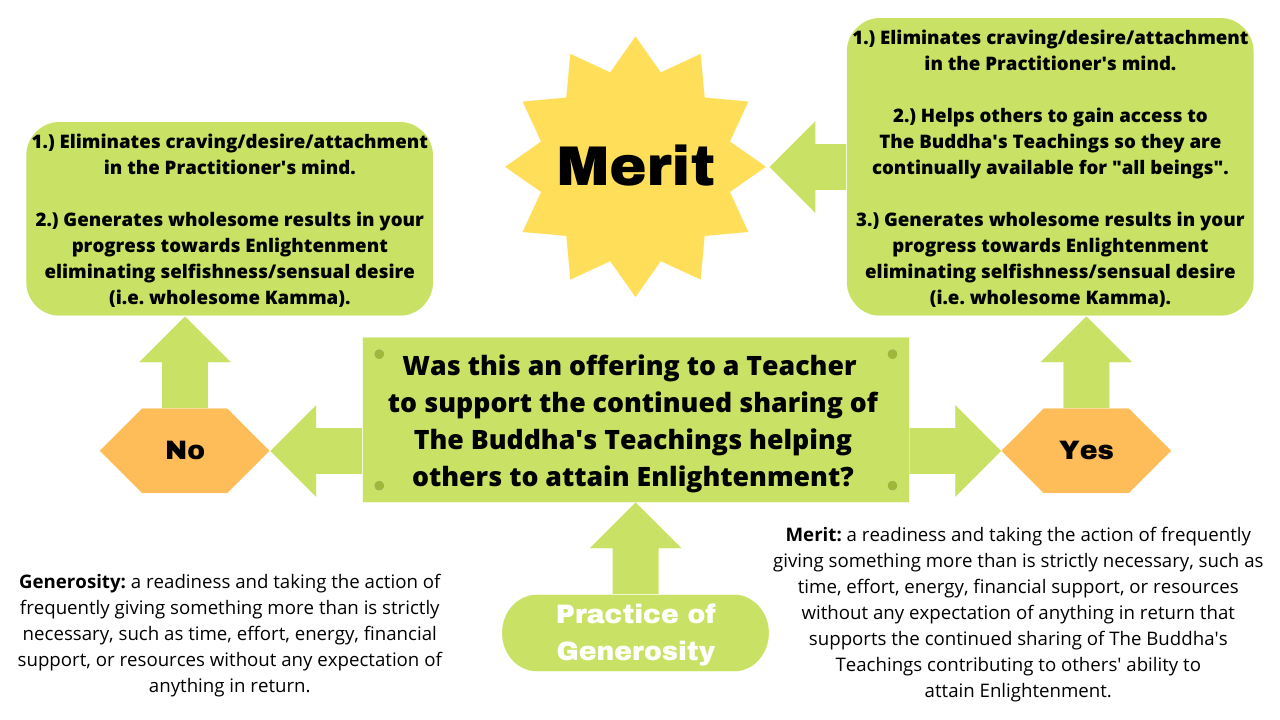
Merit is an important Teaching to understand as it relates to The Path to Enlightenment. Merit is thought of as a unique type of Kamma. Merit is wholesome Kamma generated through generous offerings and gifts to The Community of virtuous Ordained Practitioners and anyone who has attained one of The Four Stages of Enlightenment. This community of people is referred to as the “Ariyan Sangha”. Sangha is the Pāli word for “community”. The “Ariyan Sangha” is translated as “The Noble Community”.
Merit is generated by making offerings of food, water, clothing, shelter, medical care, time, effort, energy, financial support, and resources, to support the sharing of Gotama Buddha’s Teachings. It is The Noble Community who are responsible for guiding others to attain Enlightenment. Ordained Practitioners and anyone who has attained one of The Four Stages of Enlightenment are considered deep Students and Practitioners of these Teachings who support all others by guiding them towards attaining Enlightenment.
If you make offerings to these people, you are supporting the continuation of The Teachings that will help end discontentedness and the suffering it causes to all of humanity. To make offerings to The Noble Community, virtuous Ordained Practitioners, and any person who has attained one of The Four Stages of Enlightenment, you are recognizing the importance of The Teachings and supporting their continued growth. This is considered a unique type of wholesome Kamma called “Merit”.
Sharing The Teachings of Gotama Buddha requires an enormous amount of time, effort, energy, and resources. Wherever you learn these Teachings, these people need to use time and money to support their ongoing efforts to share The Teachings with you. The vast majority of people who share these Teachings with loving-kindness and compassion would never ask for a payment for sharing The Teachings but instead, offer them to you on a donation basis. The Teachings are essentially shared at no cost, for free, but those who are sharing The Teachings are spending their time, effort, energy, and resources to do the work to share with you.
Those who share The Teachings in this way are doing so with generosity, loving-kindness, and compassion for all beings. It is important that you do not just “take” this generosity, loving-kindness, and compassion, but that you also “return it back” to those who are using their time, effort, energy, and
205
resources to help you. You should also help them. As people are sharing with you, you can share with them. And, you can also initiate sharing on your own without any expectation of obtaining something in return. The practice of generosity and sharing is a powerful way to help cultivate a mind free of greed or craving.
Without sharing and practicing generosity to create Merit, a person would be unable to attain Enlightenment as the mind would still be holding on and would not have eliminated craving. It is through making offerings to the Teachers of these Teachings that one is acknowledging, with appreciation and gratitude, that The Teachings have helped them in their life, and they are making offerings to help the Teacher help others.
It is only through the generosity of people before you that The Teachings have been preserved and shared worldwide to finally reach you. The people before you have already made donations of time, effort, energy, and resources to help these Teachings reach you.
206
Now, instead of just “taking The Teachings” to benefit your life, you can also help those yet to come behind you by “practicing generosity and giving” to benefit those in the future.
Your offering that produces Merit helps those who share these Teachings with you. And you are helping those people after you who will learn and progress with these Teachings in the generations yet to come.
|
If Beings Knew the Results of Giving and Sharing Monks, if beings knew, as I know, the results of giving and sharing, they would not eat without having given, nor would the stain of selfishness obsess them and take root in their minds. Even if it were their last bite, their last mouthful, they would not eat without having shared it, if there were someone to share it with. But because beings do not know, as I know, the results of giving and sharing, they eat without having given, and the stain of selfishness obsesses them and takes root in their minds. (Gotama Buddha) (Reference: ITI 26) |
207
|
Five Benefits of Giving Monks, there are these five benefits of giving. What five? (1) One is dear and agreeable to many people. (2) Wholesome persons go in large numbers to one (you). (3) One acquires a wholesome reputation. (4) One is not deficient in the Householder’s duties. (5) With the breakup of the body, after death, one is reborn in a good destination, in a heavenly world. These are the five benefits of giving. By giving, one becomes dear, one follows the duty of the wholesome; the wholesome mentally disciplined Monks always go in large numbers to one (you). They teach one The Teachings that dispels all discontentedness, having understood which the taintless one here attains Nibbāna (Enlightenment). (Gotama Buddha) (Reference: AN 5.35) |
Oftentimes, people think one must be wealthy in assets to generate Merit. Some think to generate large quantities of Merit, one must have extreme wealth to give money, donations, supplies, etc., to virtuous Ordained Practitioners, Temples, Teachers, etc. It is thought that the more we give the more we will receive “good things” in this life or future lives, based on the total amount of money we give. This is not true.
Wealth by itself is not an indication of whether someone is a good moral person or not, and whether their deeds are wholesome. Wealth does not pave the way to Enlightenment. Just as being wealthy does not pave the way to attaining Enlightenment, being poor or having less money does not inhibit you either.
The amount of money you have acquired is not important in terms of Enlightenment. What is important is how you acquire your wealth, “Right Livelihood” (see The Eight Fold Path in Chapter 5), and what you do with it once it is acquired through your “Right Intentions, Right Speech, and Right Actions”.
208
Merit is generated and inherited by you and you alone. You are the owner of your own Merit. You are not able to transfer or inherit Merit from another person. Gotama Buddha explains clearly in his Teachings that we are the “owner and heir” of our Kamma.
Gotama Buddha taught us that “…beings are the owners of their Kamma, the heirs of their Kamma; they have Kamma as their origin, Kamma as their relative, Kamma as their resort; whatever Kamma they do, wholesome or unwholesome, they are its heirs.”
Merit is a unique type of Kamma and Gotama Buddha made it clear that Kamma cannot be transferred to another person. That it is only through our own wholesome actions that we create wholesome results. Merit cannot be accumulated and then transferred to another person. It is only through our own actions that we produce either wholesome or unwholesome Kamma.
Through practicing generosity on a consistent and ongoing basis, along with other practices, the mind is gradually trained to “let go” reducing then eliminating craving/desire/attachment to eliminate the mind’s discontentedness.
Merit and Kamma are two Teachings that are interconnected.
Practicing Generosity to Attain Merit
One of our goals in life is to create wholesome Kamma and minimize or eliminate the production of unwholesome Kamma into the world
Accumulating Merit is a way that we can put wholesome Kamma into the world. We can do this with donations, giving supplies, giving our time or effort to helping support the distribution, teaching, and sharing of these Teachings. Money, supplies, time, effort, etc., are all just some ways that we can assist in supporting the growth of these Teachings across the world.
Through supporting these efforts, one is creating Merit which is wholesome Kamma. At the same time, you would be practicing generosity which helps you to eliminate the poison of greed or craving. It is important to cultivate a mind that practices generosity to train it to eliminate the poison of greed, craving, attachment, and desire. This will help you to eliminate selfishness.
In this way, through making continuous meritorious offerings to support the sharing of these Teachings to benefit the world, you are also receiving the benefit of reduced craving. Merit and Kamma are interconnected in that through the wholesome actions of giving, you are also receiving benefits to your own practice through generosity which will reduce craving in the mind.
209
Generosity is a readiness and taking the action of frequently giving something more than is strictly necessary, such as time, effort, energy, financial support, or resources without any expectation of anything in return. A practice of giving and helping others as part of an ongoing and comprehensive life practice. This action can help you develop and cultivate a more caring and compassionate mind as one chooses to consistently give and share through their life to eliminate selfishness. Generosity eliminates craving/desire/ attachment in the mind, thus, helping to eliminate discontent feelings from the mind.
Generosity without judgment or expectation of anything in return is a practice that can transform the mind in ways you never thought possible.
Giving of time, effort, goods, supplies, or money to assist in the sharing of these Teachings will help you to create Merit. We all have something to give, and these Teachings only continue through those who are benefiting from The Teachings. The reason you are receiving beneficial Teachings is because countless people before you made offerings to The Noble Community to continue The Teachings from the time of Gotama Buddha until now. Without their generosity, you would not be able to learn and benefit from these Teachings. Your offerings to support these Teachings help you and those after you.
By giving to The Noble Community, we are practicing loving-kindness and compassion through actions to help support the continued growth of these Teachings and helping to support the learning of people after you.
Generosity is important and we should practice generosity by giving to others and important causes that benefit others. We can practice generosity not only by giving to The Noble Community but also by giving to people and charitable efforts without any expectation of anything in return. By practicing generosity of time, effort, energy, and resources, you will accumulate wholesome Kamma for yourself but more importantly, you will cultivate a mind with loving-kindness for all beings and compassion for all beings without judgment and the mind will eliminate craving/desire/attachment.
Through developing an ongoing practice of giving and helping others, we cultivate loving-kindness and compassion, while also practicing non-craving to our own possessions or wealth.
Through the personal choice of being generous and giving, it helps to eliminate the unwholesome root of craving. It is common to give to others including making offerings to a Teacher who is helping you. It is not expected
210
or required but a personal choice. You will find being generous to those around you is a helpful practice to train the mind to eliminate craving.
This understanding could lead one to think you must be wealthy and that those who are less fortunate cannot produce wholesome Kamma by practicing generosity. This could not be further from the truth, but is a common belief held by many.
The absolute best way for us to create the highest quality of wholesome Kamma is by completely eliminating the production of unwholesome Kamma. The way we do this is to practice these Teachings to include meditation.
By doing Breathing Mindfulness Meditation or Loving-kindness Meditation, we are practicing the entire Eight Fold Path during those moments, thus, all unwholesome Kamma production has ceased. During meditation, we are not producing any unwholesome Kamma. We have eliminated unwholesome Kamma production from our life for those moments of meditation.
Through the practice of meditation and elimination of unwholesome Kamma production, Gotama Buddha explains we are creating the highest level and highest quality of wholesome Kamma for ourselves which is beneficial to the entire world.
Gotama Buddha explains in his Teachings that the most expensive gifts and highest priced items given, do not generate nearly as much wholesome Kamma as one who does Breathing Mindfulness Meditation, and second to that one who does Loving-kindness Meditation.
So, accumulating wholesome Kamma does not require any money or supplies whatsoever. It only requires that we dedicate time to meditation which will produce wholesome Kamma. The ripple ‘cause and effect’ of your meditation is wholesome Kamma into the world. Thus, you can know that your individual wholesome intentions and actions of meditation will produce goodness for you and the entire world.
One does not need to be wealthy to accumulate the highest quality of wholesome Kamma, it only requires dedication and commitment to a meditation practice.
If you are able, it is beneficial to offer donations of time, effort, energy, and resources to The Noble Community to assist in the elimination of suffering in the world. Gotama Buddha’s Teachings have been carried forward over time by people like you who support Ordained Practitioners, Temples, Teachers, meditation centers and other causes associated with sharing his Teachings
211
worldwide. However, if you do not have money, you can offer your time and effort that benefit the sharing of these Teachings while also accumulating the highest form and highest quality of wholesome Kamma by doing meditation. By doing meditation, you have thus made the highest offering possible to the world by applying effort to eliminate discontentedness in the mind. When you eliminate discontentedness in the mind, you are producing less and less unwholesome Kamma that the world needs to deal with and experience from you.
Without a word spoken, the calmness felt at the end of meditation is the calmness you created in the mind. It’s like the world is quietly saying “Thank you for sending us calmness and peace. Now, we send it back to you”.
Meditation is the highest form of wholesome Kamma you can produce and, therefore the Kamma of meditation is returned to you immediately and instantaneously. Your meditation benefits you and it benefits the world. You should do meditation to benefit the mind and to benefit the world, whenever you need it and for however long you need it. A daily practice is recommended.
You can offer your time, effort, energy, or financial support to virtuous Ordained Practitioners, Temples, and Teachers who are actively applying effort to share these Teachings to generate Merit. Your time, effort, energy, and financial support is helpful to benefit you and countless others to learn these Teachings. Through the decision to support virtuous Ordained Practitioners, Temples, and Teachers, you and countless others will be able to learn and practice these Teachings creating a more peaceful world through less and less harm being produced in the world.
Teachers should not be sharing these Teachings in order to receive donations but instead, because a person has decided to leave behind worldly pursuits to share these Teachings with you, they will need donations to sustain their life and to provide the needed resources allowing them to share these Teachings with you and others in the world. By a Community providing donations to support an individual to share these Teachings, it facilitates the ability of these Teachings to more readily and deeply reach you and others in the world creating a kinder, gentler, and more peaceful society that you and everyone can enjoy.
Without the wisdom of these Teachings, the world would be lost continuing to experience heartache, misery, despair, and displeasure. Humanity would continue to suffer.
212
Supporting these Teachings by creating Merit through generous offerings to The Noble Community means that you will have the ability to gain the needed wisdom to support your life goals while improving your personal and professional relationships to enhance your life.
|
Gifts of Teachings Is Superior Than Gifts of Material Things Monks, there are these two kinds of gifts: a gift of material things and a gift of The Teachings. Of these two kinds of gifts, this is supreme: a gift of The Teachings. There are these two kinds of sharing: sharing of material things and sharing of The Teachings. Of these two kinds of sharing, this is supreme: sharing of The Teachings. There are these two kinds of assistance: assistance with material things and assistance with The Teachings.Of these two kinds of assistance, this is supreme: assistance with The Teachings. (Gotama Buddha) (Reference: ITI 100) Author’s Thoughts: The best most beneficial gift that I could ever give to you is the gift of sharing these Teachings. May you discover the freedom associated with a mind that is peaceful, calm, serene, and content with joy permanently - the Enlightened mind. As you need help to learn, reflect, and practice these Teachings, you are welcome to seek guidance which is available openly and freely to “all beings”. |
213
|
An Unsurpassed Field of Merit for the World Monks, these eight persons are worthy of gifts, worthy of hospitality, worthy of offerings, worthy of reverential salutation, an unsurpassed field of merit for the world. What eight? The Stream-Enterer, the one practicing for realization of the fruit of Stream Entry; the Once-Returner, the one practicing for realization of the fruit of Once Returning; the Non-Returner, the one practicing for realization of the fruit of Non-Returning; the Arahant, the one practicing for realization of the fruit of Arahantship. These eight persons, Monks, are worthy of gifts, worthy of hospitality, worthy of offerings, worthy of reverential salutation, an unsurpassed field of merit for the world. The four practicing the way
and the four established in the fruit; For people intent on sacrifice, (Gotama Buddha) (Reference:AN 8.59) |
Why Do Ordained Practitioners Beg for Food?
It is a common misunderstanding that people think Ordained Practitioners (i.e. Teachers) are begging for food. Ordained Practitioners are not begging for food nor anything else. They are walking through The Community providing the opportunity for Household Practitioners (i.e. Students) to practice generosity to acquire merit which will assist them in developing the mind to attain Enlightenment.
As part of what The Buddha shared as Teachings, he developed a system of “mutual support”.
The mutual support between Ordained Practitioners (i.e. Teachers) and their Students (i.e. Household Practitioners) is designed to ensure that there is opportunity for both Teachers and Students to practice The Teachings according to what leads to Enlightenment - namely “generosity”.
214
Teachers are giving up their career and worldly life. They have eliminated, or are working to eliminate, their craving/desire/attachment to worldly life of having an extensive amount of possessions, a career, etc. Through applying effort to develop their life practice to understand and practice The Teachings, they are being a deep and dedicated Student.
To be the very best Teacher, one would need to first be a very deep and dedicated Student and Practitioner.
So by living on donations of food, water, clothing, shelter, medical care, and financial support, Teachers are able to get deeper and deeper into their own practice of these Teachings to acquire wisdom of The Teachings. In this way, a Teacher is able to become a very deep, dedicated, determined, and diligent Student that leads to the elimination of craving/desire/attachment to worldly life, ultimately benefiting the Teacher and their Students. The Teacher is then better prepared to share the wisdom they cultivated on The Path to Enlightenment to help their Students to then get closer to and attain Enlightenment for themselves. It was the Student’s offerings that supported the Teacher aiding them in their journey to Enlightenment through generous donations, and it is the wisdom they cultivated that is then shared with the Students that helps them to progress in their journey to Enlightenment. This is the “mutual support” that The Buddha envisioned and created during his lifetime.
To be a good Teacher, one first needs to be a really great Student.
Through the work of being a very deep Student, a Teacher is then best prepared to be able to share these Teachings with Students to help them learn, reflect, and practice towards the attainment of Enlightenment.
A Teacher should have a well developed practice of generosity, in that, they are giving and sharing The Teachings of The Buddha without asking for anything in return. They should have no expectations of their Students and focus on sharing The Teachings with all those who have a sincere interest in learning and growing on The Path to Enlightenment.
Generosity is a significant aspect of practice that one needs to develop in order to attain Enlightenment. An individual would be unable to attain Enlightenment without a well developed practice of “generosity”.
Generosity is a readiness and taking the action of frequently giving something more than is strictly necessary, such as time, effort, energy, financial support, or resources without any expectation of anything in return. A practice of giving and helping others as part of an ongoing and
215
comprehensive life practice. This action can help you develop and cultivate a more caring and compassionate mind as one chooses to consistently give and share through their life to eliminate selfishness. Generosity eliminates craving/desire/attachment in the mind, thus, helping to eliminate discontent feelings from the mind.
Generosity without judgment or expectation of anything in return is a practice that can transform the mind in ways you never thought possible.
Students are focused on living a household life where they do have certain possessions, a career, and other aspects of worldly life. As a Student progresses forward in life, due to pollutions of mind, they will face various struggles, difficulties, and challenges. Due to the lack of wisdom of The Natural Laws of Existence, a Student will experience various challenges in life that they find difficult to overcome and it is The Teachings of The Buddha that will guide them to an improved condition of mind and life.Because a Teacher has given up their worldly life to focus on sharing Teachings with Students, Students will then provide support to their Teacher to assist them in sustaining their life and to be able to offer these Teachings to them and others throughout the world.
In this way, there is “mutual support”.
The Teachers are sharing The Teachings of The Buddha to help their Students improve their life and Students are providing life sustaining resources that support the Teacher to sustain life and acquire the needed resources to offer these Teachings to them and others.
Without this mutual support, the entire Path to Enlightenment would collapse as we see today in many parts of the world. We would find that it would be utterly difficult for anyone to get to Enlightenment without this system of mutual support.
There would not be the ability for Teachers to deeply develop their understanding and practice of these Teachings while practicing generosity by sharing The Teachings and Students would not have the ability to develop their mind by learning and practicing these Teachings while practicing generosity to support the continued sharing of these Teachings. Essentially, people would be “stuck” and unable to progress to Enlightenment because the entire system of “mutual support” would break down and there would not be the practice of generosity for Teachers and Students to get closer to Enlightenment.
216
If Teachers charged money for their services, they would not be practicing generosity. If Students are paying a fee for classes, courses, and retreats, they would not be practicing generosity. Therefore, without this regular and ongoing practice of generosity where Teachers are regularly sharing Teachings and Students are regularly sharing their time, effort, energy, and resources to help the Teachers continue to share The Teachings, the system of mutual support would not exist, individuals would not be practicing generosity, people would not be getting to Enlightenment, and The Path to Enlightenment would completely and entirely collapse.
This would leave the world without the needed Teachings of The Buddha to improve society and, thus, help all of humanity evolve to a higher consciousness where we are loving, kind, and gentle to each other while being able to acquire a peaceful and joyful mind and life.
Therefore, it is important that we do not think of it as Ordained Practitioners, including Teachers, are “begging for food”, because to “beg” would be to have craving/desire/attachment while pleading with Students to give them something. This is not what The Buddha taught as Practitioners are guided to “await what is given” rather than to have expectations that something will be given or to beg for something to be given.
Instead, The Path to Enlightenment is based on “mutual support” and through this mutual support, there will be Teachers in a Community who are interested and willing to teach based in loving-kindness, compassion, and generosity while there will be Students who have a sincere interest to learn and are willing to practice generosity to support the continued sharing of these Teachings.
In this way, Teachers have the ability to develop and Students will have Teachers available to help them develop.
If we appreciate, value, and respect Teachers who offer these Teachings at no cost, then Students will need to do their part to provide the needed support for a Teacher to exist in the world through providing the basic necessities to sustain life and resources to support the continued sharing of these Teachings.
If a Teacher is practicing in the way that is needed to share these Teachings into the world, they would use a portion of the offerings (i.e. donations) to sustain their life with food, water, clothing, shelter, and medical care and also allocate a certain amount of the resources provided by their Students towards improving their ability to share these Teachings. In modern times, this might include any of the following:
217
- Website
- Video Conferencing Membership
- Computers, Lights, Microphone, and equipment to share The Teachings.
- Meditation Cushions and Chairs - Classroom Supplies (carpets, water, cups, bathroom supplies, white board, markers, etc.)
- Signage Advertising Classes
- Transportation to and from classes, courses, retreats, and appointments with Students.
While a Teacher may offer their classes and other programs for FREE, it is not free for a Teacher to offer their Teachings. A Teacher will need support on a continuous and ongoing basis to be able to continuously share The Teachings of The Buddha.
By supporting a Teacher to share The Teachings of The Buddha, you are supporting your ability to learn The Teachings and the ability of others to learn The Teachings while training the mind to eliminate craving/desire/ attachment, the cause of discontentedness.
But, a Teacher (i.e. Ordained Practitioner) is not begging nor should they ever have an expectation of their Students to make offerings.
By a Teacher sharing their Teachings without any cost for the Student, this makes The Teachings of The Buddha available to the widest audience possible and removes any potential financial obstacle that may or may not exist for a Student. These Teachings are to help an individual rise above and move beyond the daily struggles and difficulties in their life. Many of those struggles and difficulties will hinder an individual from financial success.
If a Teacher offered their Teachings at a price for classes, courses, or retreats, an individual who is struggling with finances due to their lack of wisdom of these Teachings, would be unable to access the very solution to the struggles they face. The very Teachings they need to overcome the financial roadblocks would be inaccessible to them because there is a certain fee that is required to learn the wisdom they need to achieve improved financial success and other life successes in personal and professional relationships. Essentially, they would be “stuck” in the financial difficulties without the ability to ever learn and practice The Teachings they need to overcome their struggles in life.
Therefore, a Teacher needs to function without any selfish desires or attachment to financial success. A Teacher needs to be willing and able to offer their Teachings at “no cost”. If they assign a cost to their Teachings, there would be countless beings who would be left behind due to their
218
inability to pay for the classes, courses, and retreats that they need in order to acquire the needed wisdom to overcome their struggles and difficulties in life.
If you decide to support Teachers, Ordained Practitioners, and/or Temples, you are providing the needed resources to make these Teachings available to you and many others in the world. And, you are developing your practice of “generosity” to develop and enhance the mind towards the attainment of Enlightenment by eliminating craving/desire/attachment, the cause of discontent feelings, thus, helping to eliminate discontent feelings from the mind.
Do keep in mind, that a Teacher, Ordained Practitioner, and/or Temple should not expect, ask, nor beg for support. Instead, they would just give and share allowing their Students to also give and share.
In this way, the system of mutual support, wisely created by The Buddha during his lifetime, continues with Teachers and Students progressing towards Enlightenment through the practice of “generosity” to acquire “merit”. Through a regular, consistent, and ongoing practice of “generosity” by both Teachers and Students, The Path to Enlightenment is fully intact and accessible to “all beings”.
|
Mutual Support Between Monks, Brāhmins and Householders Monks, Brāhmins and Householders are very helpful to you. They provide you with the requisites of robes, almsfood, lodgings, and medicines in time of sickness. And you, Monks, are very helpful to Brāhmins and Householders, as you teach them The Teachings that are good in the beginning, the middle, and the end, with the correct meaning and wording, and you proclaim the spiritual life in its fulfillment and complete purity. Thus, Monks, this spiritual life is lived with mutual support for the purpose of crossing the flood and making a complete end of discontentedness. (Gotama Buddha) (Reference: ITI 107) |
To learn more about producing wholesome Kamma through practicing generosity, see the books titled “The Natural Law of Kamma” (Volume 6) and “Generosity” (Volume 13) of this same book series.
219
|
Learning Resources for Further Exploration Audiobook (Audiobook) - (Volume 1 - Chapter 10) - What is Merit? (Read & Listen) Ep. 510 - (Audiobook) - (Volume 1 - Chapter 10) - What is Merit?
Youtube Video(s) (Group Learning Program) - Chapter 10 - What is Merit and Student Discussion (Group Learning Program) - Guided Breathing Mindfulness Meditation and Student Questions Podcast(s) Ep. 450 - (Group Learning Program) - Chapter 10 - What is Merit and Student Discussion Ep. 451 - (Group Learning Program) - Guided Breathing Mindfulness Meditation and Student Questions Quiz What is Merit? (Confirm your understanding of this Chapter by completing this online quiz. You are the only person who will see the results of the quiz.) |
220