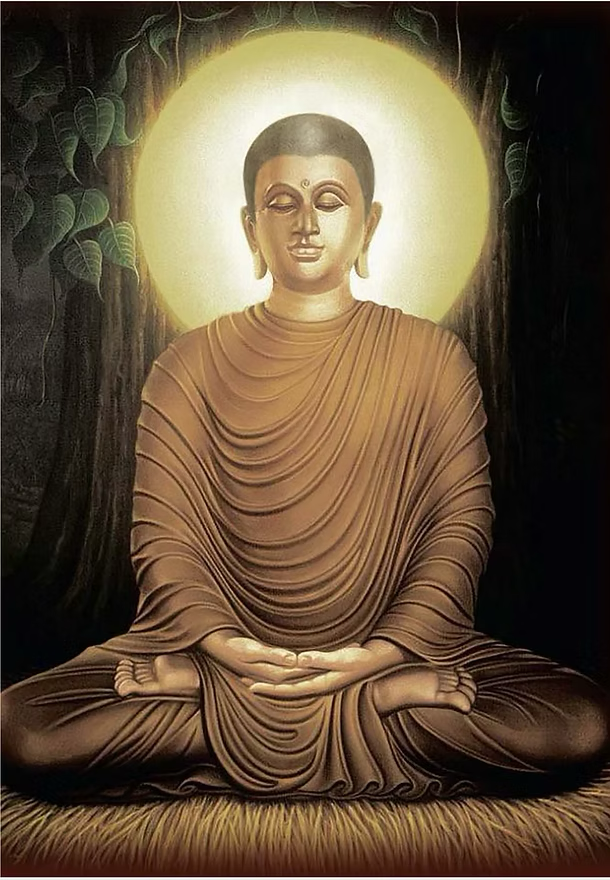
Chapter 6
The Middle Way:
Walking The Middle Way
Throughout literature, Gotama Buddha teaches and encourages us to “Walk The Middle Way”. But what does this mean and where do we find it?
During Gotama Buddha’s lifetime, he noticed that there was a stringed instrument similar to a “sitar” that only played beautiful music when the strings were tuned perfectly to “the middle”.

If the string was too tight, the instrument did not play as it was intended to play. The music did not sound beautiful.
If the string was too loose, the instrument did not play as it was intended to play. The music did not sound beautiful.
It was only when the musician had tuned the string perfectly that it would play beautiful music as the instrument was intended to play. He observed that the string needed to be tuned perfectly to “the middle”. And, when the string was tuned in this way, the instrument played beautiful music as it was intended to play and those around enjoyed the music.
He then compared this to the human mind. That the human mind is exactly the same. When the mind holds onto things too tightly, the mind is muddled and unconcentrated. The mind does not perform optimally. When the mind is
143
too loose, the mind is muddled and unconcentrated as complacency and laziness will arise. The mind is muddled and unconcentrated.
It is only when the mind is tuned perfectly to the middle by the Practitioner, that it plays beautiful music as it was intended to play. It is only when the mind is tuned perfectly to the middle, that it will experience focus, concentration, and memory with clarity of mind. And, it is The Buddha’s Teachings to understand The Natural Laws of Existence that the mind can learn, reflect, and practice to tune the mind perfectly in “the middle”.
This is one of the most simple, yet profound, Teachings that you will learn from Gotama Buddha. Tuning the mind perfectly to the middle is exactly what is happening as one progresses on their journey to Enlightenment.
There are countless Teachings to learn and understand so that you can practice. But there is no Teaching that is more simple to understand and that can be readily applied to your life, right now today, that will have more impact.
Whether it be how one chooses to engage with their personal or professional relationships, the mind needs to find the middle. If you are looking at financial decisions within your life, the mind needs to find the middle. If you need to make decisions regarding maintenance of your home or other possessions, the mind needs to find the middle way.
Even as it relates to learning and practicing these Teachings, the mind needs to find the middle way.
If the mind pushes too hard and forcefully attempts to move the mind in the direction of Enlightenment, this is not the middle and it is only going to cause the mind to be discontent. The mind will become frustrated, irritated, and annoyed because it is not walking the middle way.
If the mind is too complacent, laid back, and not interested to apply energy and effort to learning and practicing these Teachings, this is not the middle and is only going to cause the mind to be discontent. The mind will become dull, lazy, and lethargic.
It is only when the mind finds the middle and stays there that it will perform optimally moving gradually towards Enlightenment. So, where is the middle as it relates to learning, reflecting, and practicing these Teachings?
A Practitioner should be determined, dedicated, diligent, and motivated to learn, reflect, and practice The Teachings. Here, the mind can find the middle and reside there peacefully, calmly, in serenity, with contentedness and joy.
144
The mind can know that it is applying constant energy and effort to learning and progressing - neither holding these Teachings too tight nor too loose. Now, the goal is to take this lesson and apply it to everything in other areas of your life.
Whether it be with your children, life partners, parents, friends, career, personal possessions, goals, financial needs, etc., always look for the middle way.
Keep in mind that while a Practitioner will need to pursue certain goals in life, holding those tightly the mind will experience discontentedness. But also, if a Practitioner never applied effort and energy to improve their life, the mind would be too loose not being able to experience beneficial outcomes. A Practitioner will need to find the middle where it can pursue goals and objectives but also find time for rest and relaxation. The constant work and drive craving certain successes is only going to create “burn out” where the mind is no longer enjoying life but instead is highly discontent with stress, anxiety, and exhaustion not having time to gather one’s thoughts and reflect on making wholesome life choices.
Understanding that inner peacefulness is created through a balanced lifestyle (i.e. the middle way) not through the acquisition of physical or mental objects, is highly important. If the mind is constantly pursuing and chasing the objects of its affection, not enjoying the journey, this can result in many difficulties and struggles. So, be sure to pursue goals and objectives but also find time for rest and relaxation. You may need to train the mind to rest and relax as this quality is not natural but instead, oftentimes the mind needs to be trained to just relax and view that as being productive for your life and life practice. It is ok to stop and smell the flowers.
The mind will tell you when it’s not in the middle. The discontentedness of mind that is experienced is the “red light” on the dashboard alerting you that the mind is not in the middle.
If the mind is discontent, it is not in the middle. The mind is not playing beautiful music as it was intended to do. It is The Buddha’s Teachings that will provide you the remedies of how to move the mind to the middle.
- A pleasant feeling (happiness, excitement, elation, thrill, exhilaration, euphoria, etc.)
- A painful feeling (sadness, anger, frustration, irritation, annoyance, guilt, shame, fear, stress, anxiety, etc.)
- A feeling that is neither painful-nor-pleasant (boredom, loneliness, shyness, displeased, uncomfortable, unsatisfied, etc.)
145
If the mind is experiencing any discontentedness whatsoever of pleasant feelings, painful feelings, or feelings that are neither painful-nor-pleasant, then the mind is not tuned to the middle and there is more work to be done to further tune the mind and get it to stay there through developing a life practice based on The Eight Fold Path.
This requires you to develop a life practice through consistent and comprehensive learning, reflecting, and practicing these Teachings with guidance from a Teacher.
Progress will be gradual, but within a short period of time you will notice a difference as the mind gradually becomes less and less discontent. There will be situations that once produced anger, sadness, frustration, irritation, and annoyance in the mind, but those same circumstances will arise and the mind will be able to maintain its calmness and composure. This is how you will know The Teachings and practices you are implementing are working. You will see the truth for yourself. You will not need to believe these Teachings as you will see the truth that the mind is gradually becoming more peaceful, calm, serene, and content with joy in countless situations until eventually, the mind is perfectly tuned to the middle and stays there permanently. This is a mind that is experiencing Enlightenment.
If we are sad and feeling down, we aren’t walking the Middle Way. There is discontentedness of mind. But this is a temporary emotion and we know it will not be forever, because Gotama Buddha teaches us that everything is impermanent except for Enlightenment and The Natural Laws of Existence. You can see this truth for yourself as the mind constantly moves from feeling to feeling, emotion to emotion. You can observe this as truth that no feeling is indeed permanent. Your sadness will eventually dissipate and you will slide into other emotions even if that takes, hours, days, weeks, months, years, etc.
But some of us dwell in the sadness, feeling so sad and thinking that we are going to be in this condition for so long. We keep repeating these sad thoughts in the mind over and over and over. So, what we get is sadness because that’s all we are thinking. One moment leads to the next so we are filling up this moment with sadness, so we get sadness in the next moment. So what we experience is a feeling of never ending sadness. We are highly discontent in this situation and certainly not “Walking The Middle Way” because we are sad.
Perhaps feeling sadness, we turn to happiness thinking that will save us. We turn to happy friends, happy occasions, happy situations, but somehow the mind keeps returning to the sadness or perhaps it stays in the happiness
146
and we are just happy, happy, happy. So happy, we joke all the time, we make others laugh, we go out of our way to show happiness in all situations. We may be truly happy and gleeful or we might be covering up the sadness. But this is a temporary emotion as well. Happiness will end some day and, thus, we cycle back and forth between happiness and sadness. We are gleeful and then we are not - never finding that middle ground, so to speak, or contentedness.
Oftentimes, we are encouraged by self-help books, life coaches, friends, family, and all kinds of input into our senses to be happy, just be happy. I want to be happy. Why can’t I just be happy?
Well, the goal is not to be happy. The goal is to be peaceful, calm, serene, and content with joy or to be “satisfied with what is”, “satisfied the way things are”. That is the true goal and that is “Walking The Middle Way”.
We can’t be happy (pleasant feelings) all the time, because we know that is a temporary emotion subject to impermanence, and we for sure are not interested to be sad (painful feelings) all the time. The third option would be boredom or loneliness (feelings that are neither painful-nor-pleasant) which is also impermanent, therefore, the best option is to create a life where we “Walk The Middle Way”.
The mind can reside in the middle peaceful, calm, serene, and content with joy. This is Enlightenment, it is permanent because to attain Enlightenment you need to obtain wisdom through these Teachings which liberates the mind.
Once you learn something, you do not “unlearn” it, thus, Enlightenment is a permanent state of mind. The mind can reside peaceful, calm, serene, and content with joy permanently unaffected by the impermanent nature of all “things”.
As we pursue Enlightenment, that does not mean we can’t laugh, we can’t cry if we need to, we can still experience these other emotions on all sides of the spectrum. It simply means that when we feel those emotions, we need to recognize them as being impermanent and train the mind to come back to the middle where it can reside peaceful, calm, serene, and content with joy.
Do not try to maintain these impermanent emotions of happiness, sadness, or loneliness, but rather actively apply effort to bring the mind back to the middle with meditation, reading, activities that are grounding, outdoor activities, gardening, massage treatments, whatever we need to help bring the mind back to the middle and a wholesome state. Over time, you will be
147
able to maintain the “middle way” through your “life practice” which includes meditation.
Apply The Seven Factors of Enlightenment from the Chapter titled “Enlightenment: What is Enlightenment?” (Chapter 3) to move the mind into the middle along with all The Teachings as part of The Eight Fold Path.
Often, the first thing people tell you when you are sad is “snap out of it, go outside, do something”. What they are really saying is “change your state of mind”. Put the mind in a different environment so that it can experience a new emotion and cultivate the healthy vibes of something else. By focusing on something that will bring the mind back to the middle, the mind will go there. Maybe not right away, but with training and experience you will find this becomes easier and easier until eventually the mind will be peaceful, calm, serene, and content with joy 100% of the time with an unshakable inner peace.
Moving the mind to the middle is an application of Right Effort, taking the effort to eliminate the unwholesome qualities and arise the wholesome qualities. So, as you observe the mind is discontent, eliminate that from the mind by cutting off those thoughts and letting them go. Take the effort to move the mind in the direction of the middle way where the mind can be peaceful and calm.
The same Teaching of The Middle Way can be applied not only to happiness and sadness but also to money, possessions, relationships, trust, love, compassion, excitement, etc. We must always walk the Middle Way, because if we have craving, desire, or attachments, we will cause discontentedness for the mind.
Finding the Middle Way and staying there is a “practice” in your LIFE PRACTICE!!!
It is possible to love and have love for others without being attached or clinging to them. We must allow all beings to follow their path without being affected by our own attachments or aversions. If we try to block people from pursuing their goals, try to get them to stick close to us, or persuade them to follow what “we want” rather than what “they need”, then it is difficult for those close to us to find and follow their own path. Likewise, if we have aversion and keep ourselves or others “away” from certain aspects of our life, we potentially lose the opportunity to gain insight or wisdom from a given situation.
One aspect of a meditation practice is to develop the ability to see the emotions, thoughts, and feelings that aren’t in the middle, then, you can use
148
techniques to bring the mind back to the middle. Breathing Mindfulness Meditation in the positions of seated, lying, or standing along with walking meditation are perfect for finding the middle way and staying there while also training the mind not to cling or attach. Then, apply effort to consistently maintain the middle way throughout your day. Whenever you noticed the mind is not in the middle, take active steps to move the mind back to the middle by cutting off unwholesome feelings and let them go. This becomes easier as a Practitioner accumulates the benefits of a well developed Breathing Mindfulness Meditation practice.
Eventually, the mind will be trained to always stay in the middle and you will not need to apply this effort. But, as long as the mind is longing with a strong eagerness and pulling in the direction of its cravings/desires/attachments, you will need to apply effort to cut those off and let them go. The mind will eventually get tired of this repeated cutting off and will choose to stay in the middle. It is just going to take time, effort, and dedication to develop your life practice.
You will need to study Gotama Buddha’s Teachings and practice them diligently before everything will click, and each day all The Teachings and practices will lead you further on The Path to Enlightenment as the mind becomes more trained. It is peaceful when you can experience life without discontentedness or even the slightest suffering of the mind.
Why wait to the end of your life to know what will happen, when you can experience Enlightenment during this life and enjoy it for the rest of your life. You can study the practices shared with us by Gotama Buddha, practice those daily, and experience Enlightenment.
Getting to Enlightenment is not meditating and hoping you will get there one day. Breathing Mindfulness Meditation is a tool to train the mind to not cling or attach and bring it to the present moment but takes practice. Breathing Mindfulness Meditation will help you train the mind to eliminate the mind’s “wanting”, “craving”, and “clinging” so that you can eliminate the mind’s tendency to form attachments - a mental longing for something with a strong eagerness. This is how the mind pulls in the direction of the objects of its affection and, thus, the mind is not in the middle.
You have to pursue your own Enlightenment through a daily practice of learning and implementing The Teachings into your life. By doing this, you will start to see the results of the difficulties in your life slowly start to disappear - life changes for you. You gain a higher level of consciousness that equips you with new tools to handle life and respond to the situations around you.
149
As you seek Enlightenment, life problems are not going to instantly vanish - the way we usually picture heaven. Nope, you are still on earth in a world full of discontentedness and the suffering it causes. But when you have attained Enlightenment, you have a new mind through having acquired new wisdom to deal with the impermanent nature of existence and you will not allow impermanence to affect the mind. You will no longer be affected by pleasant feelings, painful feelings, or feelings that are neither painful-nor-pleasant.
Once you step forward into the light, there is no going back into the darkness. The mind will be liberated with the wisdom you acquire in your practice.
Unfortunately, many of us make ourselves way too busy with regular life that we do not take the time to study The Teachings and implement them into our practice or daily life. The mind becomes complacent and struggles through life just accepting the difficulties of experiencing repeated discontentedness rather than take action to eliminate it from the mind. Those who do implement these Teachings can tell you, they are experiencing the results as the mind moves closer to being peaceful, calm, serene, and content with joy.
Anyone that has dedicated time to learn and implement Gotama Buddha’s Teachings will tell you without a doubt their life has improved greatly from the time prior to learning and implementing his Teachings.
Now, you can apply this Teaching of the middle way to your life and life situations. As you need guidance, you are welcome to reach out to seek guidance to more deeply understand and apply these Teachings into your life.
150
|
Adjusted to a Balanced Pitch Tell me, Soņa, in the past, when you lived at home, weren't you skilled at the lute (a stringed instrument)? ‘Yes, Venerable Sir.’ What do you think, Soņa? When its strings were too tight, was your lute well tuned and easy to play? ‘No, Venerable Sir.’ When its strings were too loose, was your lute well tuned and easy to play? ‘No, Venerable Sir.’ But, Soņa, when its strings were neither too tight nor too loose but adjusted to a balanced pitch, was your lute well tuned and easy to play? ‘Yes, Venerable Sir.’ So too, Soņa, if energy is aroused too forcefully this leads to restlessness, and if energy is too soft this leads to complacency. Therefore, Soņa, be determined on a balance of energy, spiritual faculties, and take up achieving evenness of the object there. ‘Yes, Venerable Sir,’ the Venerable Soņa replied. (Gotama Buddha) (Reference: AN 6.55) |
151
|
Walking The Middle Way - Two Extremes That Should Not Be Followed Monks, these two extremes should not be followed by one who has gone forth into homelessness. What two? The pursuit of sensual happiness in sensual pleasures, which is low, vulgar, the way of worldlings, not honorable, unbeneficial; and The pursuit of self-mortification, which is painful, not honorable, unbeneficial. Without veering towards either of these extremes, The Tathāgata has awakened to the middle way, which gives rise to vision, which gives rise to wisdom, which leads to peace, to direct knowledge (experience), to Enlightenment, to Nibbāna. And what, Monks, is that middle way awakened to by The Tathāgata, which gives rise to vision, which leads to Nibbāna (Enlightenment)? It is this Noble Eight Fold Path; that is, Right View, Right Intention, Right Speech, Right Action, Right Livelihood, Right Effort, Right Mindfulness, Right Concentration. (Gotama Buddha) (Reference: SN 56.11) |
152
|
Walking The Middle Way - Two Extremes That Should Not Be Followed (continued) Author’s Thoughts: This Teaching from Gotama Buddha helps a Practitioner understand that seeking pleasant feelings or “sensual happiness” in “sensual pleasures” will not lead to Enlightenment. In fact, training the mind to not seek inner fulfillment in sensual pleasures is a major aspect of The Path to Enlightenment. This does not mean that a Practitioner is unable to enjoy the many aspects of life, but it is when the mind mistakenly believes that it is sensual pleasures that will create lasting inner fulfillment that the mind causes itself to be discontent because it is then basing its inner feelings on impermanent conditions. And, if the mind mistakenly believes that “self-mortification” or depriving the senses through harsh practices is what will produce the Enlightened mind, then it is misunderstanding and not practicing “The Middle Way”. Gotama Buddha awakened to Enlightenment where the mind is peaceful, calm, serene, and content with joy through “the middle way”. His mind functioned in the same way as yours and through understanding the middle way, a Practitioner can experience Enlightenment just like Gotama Buddha. If sensual desires for pleasure nor self-mortification is the middle way, then what is “the middle way”? Gotama Buddha makes clear in countless Teachings, including this one, that it is The Eight Fold Path that leads to the complete elimination of all discontentedness and here he refers to it as “the middle way”. Through learning, reflecting, and practicing The Eight Fold Path, a Practitioner trains the mind to reside in the middle being perfectly tuned to not chase after the objects of its affection through sensual desire, but also needs to train the mind to not inflict physical pain through depravation of the senses. It is only when a Practitioner finds the middle and trains the mind to stay there that they will experience permanent focus, concentration, deep memory, and clarity of thought as the mind performs as it was intended to function. The Enlightened mind will be trained to reside in the middle permanently. |
153
154