Chapter 19
The Difficult Human Existence:
Sickness, Aging, and Death
Three aspects of life that are the most difficult for us to deal with in our human existence are sickness, aging, and death.
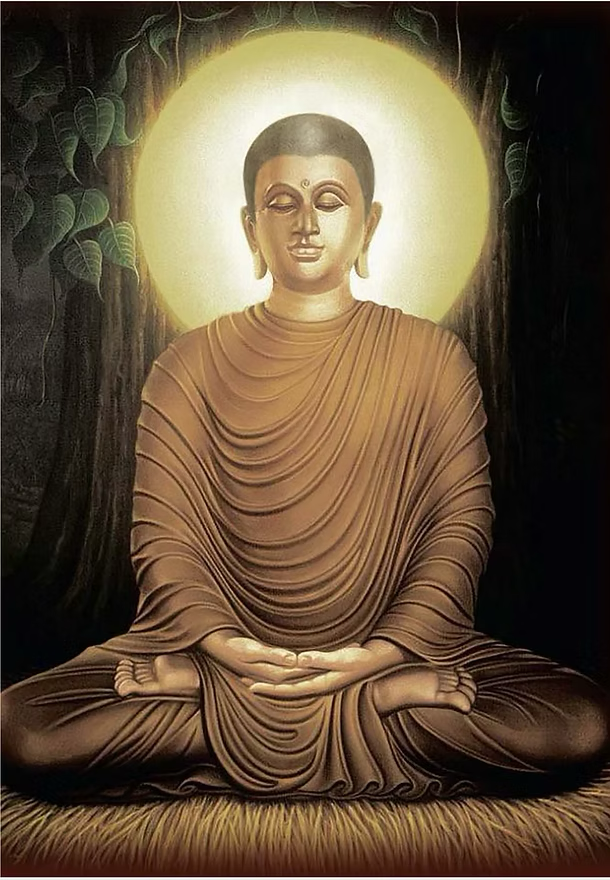
The young Prince Siddhartha Gotama, who eventually became Gotama Buddha, was sheltered during his first 29 years of existence as his father, the King, was keeping him in the palace attempting to lure him into the ways of a monarch through keeping him attached to the luxurious life of being a Prince and eventually a King.
At the age of 29, Siddhartha Gotama exits the palace for the first time without his father’s knowledge to observe life outside the palace. He had his attendant with him who helped explain Siddhartha Gotama’s four (4) observations of sickness, aging, death, and an Ascetic or monk - a spiritual seeker.
Siddhartha Gotama was passionately interested in understanding the nature of life and why beings experience sickness, aging, and death along with the associated discontentedness of mind. He observed the Kingdom was full of discontentedness and was not interested to rule over the hardship that he observed. Instead he was interested in finding the answers to what plagued the people of the Kingdom to help them, and decided to embark on a spiritual journey that ultimately led him to Enlightenment and all the answers to his questions.
The motivation and determination of Siddhartha Gotama eventually led him to the understanding that because of the impermanent nature of all conditioned objects and the mind’s craving for permanence, we cause our own discontent mind. Through a lack of wisdom, the mind is ignorant (unknowing of true reality) of The Natural Laws of Existence and, thus, beings are trapped into a Cycle of Rebirth repeatedly experiencing sickness, aging, and death.
It is not until we learn, reflect, and practice The Teachings to eliminate the discontentedness in the mind attaining Enlightenment that we solve the discontent mind and escape The Cycle of Rebirth. Only then, will our constant wandering and roaming be eliminated residing peaceful, calm, serene, and content with joy - permanently.
333
Sickness
The health of our physical body is important and we should maintain our health through a proper food supply and other prudent activities. We need to give the body what it needs to maintain its health. If the body ceases to exist through death, then the mind cannot stay in the current human form to cultivate the consciousness. If we do not attain Enlightenment, we will be reborn thus, our difficult experiences continue.
Sickness is a major challenge in our human existence. Oftentimes when we are sick, we might moan or groan about our illness. Our normal activities might cease and thus our attachment to being active and to wanting permanent health of the physical body causes the mind to be discontent.
It is important that we seek help for our sickness but in doing so, understand that sickness is part of the human existence. We cannot escape this as part of our human condition. The body is impermanent and we will not always be healthy. If we are human, we will be sick.
During times of sickness, it is easy for the mind to stop practicing these Teachings and perhaps talk poorly to people around you and have poor actions while feeling miserable. The mind is often highly discontent when we are sick.
The “cause and effect” of The Natural Law of Kamma does not stop just because we are sick. Being sick is not an excuse for being impolite, unkind, unfriendly, and disrespectful to others.
Be sure you continue to practice The Teachings shared in this book which includes Right Intention, Right Speech, and Right Action along with all the other Teachings. If we speak kindly and politely to those caring for us during our sickness, it will continue to create wholesome Kamma and we will experience excellent care as people will be pleased to help us.
Aging
Aging is a challenge of life. As we age, our youthful appearance fades and if we are attached to our youthful appearance, we may take drastic steps to continue looking youthful that can cause discontentedness.
By attaching to our youthful appearance, we may opt for costly medical procedures or go down the path of extreme efforts to maintain our youth. This would require extensive effort all to please the mind that “craves” a youthful appearance rather than accepting that we all age. It is a normal part of life and the human existence.
334
Aging brings challenges with the physical body that we all experience. We experience aches, pains, and difficulties that we did not have during our more youthful days. We need to accept this as part of the human existence while recognizing it is impermanent. We will not always look or feel the same as the body ages as the body is impermanent.
If you are attached to your youthful appearance and constantly “crave” youthfulness, the mind will be discontent. If you are attached to the physical body and constantly “crave” to never feel pain, the mind will be discontent. These things are all impermanent and if the mind is clinging to permanent youthfulness or permanent comfort in the physical body, there will be discontentedness.
Death
Death is one of the biggest challenges for humans to accept and understand. Accepting our own death and the death of those close to us can be extremely challenging. There are major attachments to our friends and family unless you have learned and are practicing “love without attachment”. Upon the death of friends and family or our own death, it’s the end of our time together in this existence without any chance to ever again resolve any undiscussed concerns or dilemmas.
Death can be a time of grave and deep discontentedness or despair due to the burden of significant attachment and the sometimes abrupt end of life rather than a gradual letting go. Even with gradual death, it can often be a challenge for humans to accept and deal with when the mind is craving permanence.
A friend or family members’ death does not need to be taken as a tragic loss. Through understanding and practicing these Teachings, you can accept death as a natural and normal occurrence that will happen because we are humans and we must die. The human condition means we were born and thus we will experience sickness, aging, and death. The mind craves for permanent health, youthfulness, and for those close to us to be with us permanently. The unEnlightened mind is uncomfortable with the impermanent nature of the human condition and when we experience sickness, aging, and death this represents significant impermanence in our life. Therefore, the unEnlightened mind is often discontent associated with these unwelcome changes in our life.
The mind can be trained to understand and accept the impermanent nature of the human condition, residing peaceful and calm even during sickness, aging, and death.
335
Death does not need to involve sadness, grief, and remorse. These are feelings produced due to attachment and the mind causing itself to be discontent. If there is love without attachment, you can experience death of those close to you without sadness, grief, nor remorse. You can have gratitude for the time you spent together rather than craving/desiring permanence which will only cause discontentedness.
Gotama Buddha explained to us that there is only one reason why we die and it’s because we were born. Because there is birth, there is sickness, aging, and ultimately death. This is the human condition and Gotama Buddha’s Teachings help us to eliminate all three of these by escaping The Cycle of Rebirth. If we are not born, then we will not experience sickness, aging, nor death.
It is ignorance (unknowing of true reality) that the unEnlightened mind does not understand what it does not understand that continues us in constant rounds of The Cycle of Rebirth. It is only when the mind acquires wisdom, that it is liberated from discontentedness experiencing Enlightenment and at the same time liberated from The Cycle of Rebirth.
Gotama Buddha did not teach what happens after death once we have already attained Enlightenment. The Teachings of the “afterlife” is an undeclared Teaching. He did explain that we can attain Enlightenment during this life or at death. He left The Teaching undeclared of what transpires once one attains Enlightenment and then dies, because knowing the answer to this question does not change or effect our ability to attain Enlightenment in this life in this human state.
No one has ever attained Enlightenment and returned, since one who has attained Enlightenment would not return back to any future existence in The Cycle of Rebirth. Therefore, it is an undeclared Teaching of what happens once one attains Enlightenment and dies. Gotama Buddha’s goal was to focus the mind on attaining Enlightenment in this very life so that we could escape The Cycle of Rebirth and no longer experience existence in The Cycle of Rebirth which would only bring sorrow, misery, displeasure, and despair. The Enlightened mind will only experience peacefulness, calmness, serenity, and contentedness with joy - permanently.
If we still have craving at the end of this life, that is the fuel that will cause us to remain in The Cycle of Rebirth and be reborn into another realm. If we have not attained one of The Four Stages of Enlightenment, we will most likely be reborn into a lower realm of existence such as hell, animal, or the afflicted spirits realm although there is the opportunity to be reborn back into the human realm or the heavenly realm. None of the existences in any of the
336
realms is permanent and it is not until one attains Enlightenment that they will eliminate discontentedness and escape The Cycle of Rebirth.
Siddhartha Gotama eventually left his royal heritage to seek a better understanding of these observations of sickness, aging, and death to help end discontentedness of the mind. He became a homeless roaming Ascetic seeking a better understanding of life to resolve the significant discontentedness he observed with the human existence.
He was not interested to be a ruler over people in misery and pain with discontentedness affecting the mind. Instead he looked for answers to the most significant problems that existed in the world - sickness, aging, and death. The young Siddhartha Gotama was interested in understanding why these three human conditions caused such significant discontentedness of mind.
Through his six (6) year pursuit, he gradually awakened the mind as The Fully Perfectly Enlightened Buddha finding the answers to these questions and many others. He contemplated for seven (7) weeks of whether to teach his new found wisdom, as he did not think the world was ready for The Teachings.
Gotama Buddha returned to teach five (5) Ascetics he knew prior to his independent pursuit of Enlightenment. They did not believe that he was Enlightened so he sat down and touched the earth with his hand to call on the animal kingdom to give witness of his attainment of Enlightenment. Animals came from all directions and the Ascetics had confidence in him and then listened to his Teachings and The Community of Enlightened beings flourished.
It is said that immediately upon Gotama Buddha’s death, there was a significant earthquake that shook the earth.
An earthquake following the death of a Buddha is an indication to those who remain alive that this person was indeed a Buddha. This helps those who did not learn and practice his Teachings during his lifetime that, with the confirmation that he is a Buddha, they would be wise to learn, reflect, and practice his Teachings to attain Enlightenment with those who remain alive.
These two examples are the only significant miracles I am aware of that were said to have happened during the lifetime of Gotama Buddha and that I know to be true. From this point forward, he provided Teachings that could be understood and then practiced so each person can observe the truth and gain wisdom for themselves liberating the mind from strong feelings.
337
Gotama Buddha helped others to attain Enlightenment through his Teachings and guidance out of compassion for the world.
Gotama Buddha’s Teachings do not require belief as you can see the truth from your own practice of his Teachings as the condition of the mind gradually improves. You learn The Teachings, practice The Teachings, gain wisdom that liberates the mind and gain the results of a better, more peaceful, and more calm existence.
As the mind experiences Enlightenment, it will reside peaceful, calm, serene, and content with joy being unaffected by sickness, aging, or death. The Enlightened mind is unshakable even by the most significant challenges in life.
An Enlightened being will no longer experience any discontentedness related to sickness, aging, nor death, or any other aspect of life. The mind is steady, calm, stable, and unshakeable. The mind has been liberated and experiences permanent peacefulness.
338
|
Learning Resources for Further Exploration Audiobook (Audiobook) - (Volume 1 - Chapter 19) - The Difficult Human Existence: Sickness, Aging, and Death (Read & Listen) Ep. 519 - (Audiobook) - (Volume 1 - Chapter 19) - The Difficult Human Existence: Sickness, Aging, and Death Youtube Video(s) (Group Learning Program) Chapter 19 - The Difficult Human Existence: Sickness, Aging, and Death (Group Learning Program) - Guided Loving-kindness Meditation and Student Questions Podcast(s) Ep. 477 - (Group Learning Program) Chapter 19 - The Difficult Human Existence: Sickness, Aging, and Death Ep. 478 - (Group Learning Program) - Guided Loving-kindness Meditation and Student Questions Quiz The Difficult Human Existence: Sickness, Aging, and Death (Confirm your understanding of this Chapter by completing this online quiz. You are the only person who will see the results of the quiz.) |
339