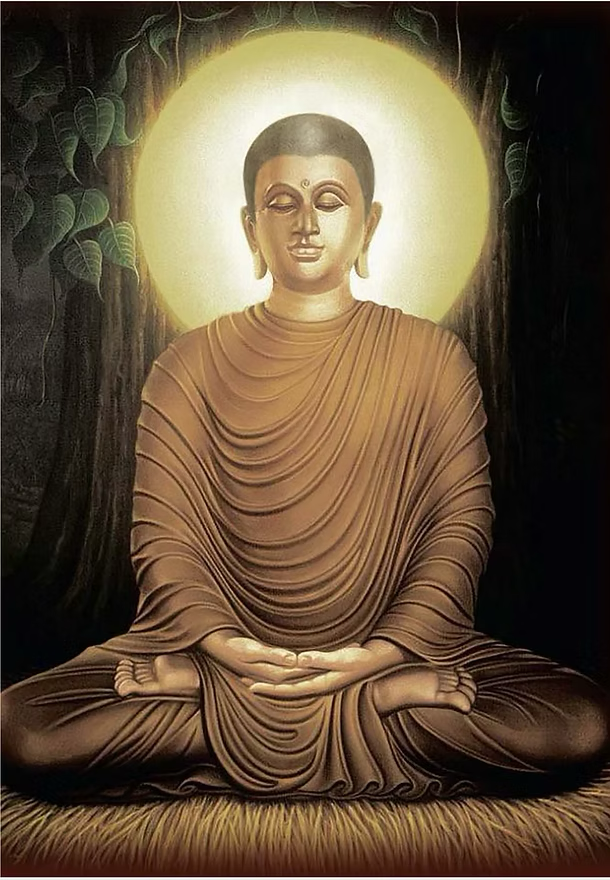
Chapter 15
True Love:
Love Without Attachment
Having caring and loving relationships is an enjoyable part of life. It is possible to have care and love for other people while practicing these Teachings. In fact, a Practitioner of these Teachings will find that care and love are central aspects at the core of these Teachings. But you will need to understand what is “true love” in order to experience the joy of loving relationships without attachment.
You may find yourself currently defining love as attachment. What you may see as love is actually not love at all but attachment.
You seek out relationships or look within existing relationships for how the other person will make you happy. You desire for the relationship to create happiness for you. You seek happiness through relationships with others as if these relationships will help to “complete” you, making you feel whole.
We tend to sabotage relationships by inadvertently placing unrealistic obligations and expectations on the other party to make us happy, when it is impossible for anyone to meet this expectation. The feeling often becomes that “I love you” and therefore I expect you to make me happy.
We may form expectations for the other person in a relationship far beyond just the need to make us happy. The obligations and expectations we form are mental cravings/desires/attachments that constantly change because they are impermanent. The other person will find it impossible to meet ever changing and unrealistic expectations we have for them, especially considering these unrealistic expectations are oftentimes unspoken.
Even if we did share our expectations for the other person, the expectations are still cravings/desires/attachments we have that unless met, will cause the mind to be discontent. The expectation that we will be “happy” all the time in a relationship is actually an unrealistic expectation as happiness is impermanent and is not lasting.
The mind creating expectations in this way forms attachment to the other person. The mind is relying on the other person for comfort and pleasant feelings, therefore not being content on your own. We often think that
280
without this other party in our life, we are unable to be happy or have fulfilling experiences.
It is this “mental longing for something with a strong eagerness” (i.e. craving/ desire/attachment) we have for another party to make us happy that forms our mental attachment, that will lead to a discontent mind. Any and all attachments will lead to discontentedness of mind. So we must learn to have care and love without attachment to others.
If you form obligations and expectations for the other person to fulfill, those obligations and expectations are impermanent in that they will never remain the same. Therefore, the other person will find it impossible to fulfill your expectations and the mind will be discontent because things do not happen as you expect.
As you move forward in a relationship with craving/desire/attachment, you may find that you argue, fight, or have disagreements that lead to frustration, irritation, and tension in the relationship because both parties are pulling in opposite directions towards the very different obligations and expectations of each person.
The pleasant feelings that once existed are no longer present or part of the relationship, so one or both people lose interest in the relationship.
The other situation might be that both people continue to struggle trying to make the relationship work, not realizing that it is actually their own obligations and expectations, i.e. cravings/desires/attachments, that are making it increasingly challenging to have a peaceful relationship. We are actually sabotaging our own ability to have a successful relationship. We oftentimes think the other person is the problem, rather than look at our own mind for the source of the problem.
Even if the relationship starts heading in the same direction with similar expectations, those expectations change due to impermanence and leads to problems as the relationship continues.
Eventually both parties in the relationship will end up with very different expectations and neither are being fulfilled 100%, so the mind of one or both becomes discontent with less and less interest in maintaining the relationship. It feels that the love is gone but, in fact, it is the unfulfilled obligations and expectations, i.e. cravings/desires/attachments, that are causing the mind to be discontent.
Attachment in relationships will lead to tension and conflict that ultimately becomes division and separation, oftentimes lasting an entire lifetime.
281
It feels that the love is gone because neither person is getting what they “want”, “desire”, or “crave” in the relationship when if there were no obligations or expectations, the relationship could be peaceful.
You may even decide to block people from your life who are disagreeable to you, erecting walls to ensure you have no contact with these people. This is aversion.
Of course, there needs to be politeness, kindness, friendliness, and respect within all relationships, but other than these basic foundations of any healthy relationship, we typically have obligations and expectations far beyond these basic foundational requirements. We can oftentimes hold relationships too tightly with obligations and expectations and because of that, we “crush it”.
Ideally, both people would already be fulfilled and come into the relationship appreciating each other and their individual contentedness. But, this is rare and is why relationships are oftentimes a significant struggle for the unEnlightened mind where you experience many difficulties in developing and maintaining relationships due to the constant arising of discontentedness within the relationship.
What is True Love?
True love is to have care for another person, not wanting anything specific from the relationship but instead, only having an interest to see this person be well and peaceful. A relationship with true love would be formed and conducted with no intentions or interest other than to see the person succeed in life in whatever way they choose to progress and walk forward. We “love them as they are”.
Having a relationship without craving/desire/attachment would involve allowing an individual to walk whatever path they choose while you show care and support along the way. You would not have obligations nor expectations of who they are or what they should become but instead, allow their life to flow and progress based on their own personal choices, uninfluenced by obligations or expectations from you. This is true love, and this unconditional love can be permanent.
This type of relationship is possible with life partners, children, parents, friends, and any other relationships we form. We can have unconditional love for “all beings” when a Practitioner understands true love and practices true love.
Until you have learned these Teachings and practice establishing relationships with “true love”, most will find creating relationships with “love”
282
very difficult and unpleasant. This is because we tend to approach relationships with an understanding that craving/desire/attachment is love, rather than understanding how to love and care for someone by practicing “true love” without attachment.
It is not until the mind wakes up to understand this wisdom, learning and practicing “true love” that you will find relationships more relaxed, enjoyable, and without stress. Otherwise, the obligations and expectations you have for the people around you will create hostility and complications, that will make it difficult for you to experience caring, loving, and lasting relationships.
No one is ever going to meet all the obligations and expectations you have for them, so eliminate the expectations, eliminate the cravings/desires/ attachments, and you will find rewarding and successful relationships which are quite enjoyable and even more fulfilling.
Judgment and expectations of others make it difficult to see others as “they truly are” and “love them as they are”.
Love Ourself
Just as we have expectations for others, which can stand in the way and cause conflict, having excessive or unrealistic expectations for ourselves can create internal conflicts. Negative self talk, guilt, shame, and other feelings can all manifest through craving/desire/attachment to thoughts, ideas, perceptions, obligations, and expectations we have of ourselves.
If we judge ourself, we often judge others as well, causing the mind to be discontent. Negative thoughts directed at us from our own mind can be eradicated by eliminating negative thoughts or judgment towards others.
It is best to have dedication and commitment to learning and practicing these Teachings with understanding that gradual training will be needed to attain results. If we have expectations for drastic and quick improvements, this craving for rapid success or other expectations will only cause a discontent mind.
To have ego or conceit based love towards ourself, is unfruitful. However, having a positive and wholesome outlook for ourself, others, and the world around us, will produce a healthy mind.
283
Love for Parents or Caregivers
Gotama Buddha’s Teachings share many important Teachings related to relationships with others especially our parents. Today, parents could be our biological parents, adopted parents, grandparents, or other caregivers who provide us our start in life and look after us.
It is these people who provide us clothing, food, books, education, and other necessities to start our life, and who have the most influence on shaping the mind. They are our “original Teachers” that gave us our start in life understanding how to complete basic tasks like brushing our teeth, cleaning the body, eating, urinating, defecating, and other life sustaining activities. Some parents or caregivers have provided us wisdom well beyond these basic tasks. Without this guidance, we would be unable to sustain our life.
Having healthy relationships with all people is important but it is very important that we show our gratitude to those caregivers who provide us care to sustain our life and attempt to give us life lessons to assist us on our journey in this life.
Whether this is the first book you have ever read that shares Gotama Buddha’s Teachings or not, you have always had people around you that taught you that it is unwise to kill other beings, to steal, to commit sexual misconduct, to lie, and to ingest substances that cause heedlessness. These initial lessons are typically shared with us by our original Teachers, our “parents” or “caregivers”.
The below Teaching is directly from Gotama Buddha that can help you to understand one of his Teachings related to caring for our parents, our “original” and oftentimes “most dedicated” Teachers.
We should always and forever look for ways to show gratitude, respect, and dedication to our parents or caregivers.
284
|
Repaying One’s Mother and Father Monks, there are two persons that cannot easily be repaid. What two? One’s mother and father. Even if one should carry about one’s mother on one shoulder and one’s father on the other, and (while doing so) should have a life span of a hundred years, live for a hundred years; and if one should attend to them by anointing them with balms, by massaging, bathing, and rubbing their limbs, and they even void their urine and excrement there, one still would not have done enough for one's parents, nor would one have repaid them. Even if one were to establish one’s parents as the Supreme Lords and Rulers over this great earth abounding in the seven treasures, one still would not have done enough for one's parents, nor would one have repaid them. For what reason? Parents are of great help to their children; they bring them up, feed them, and show them the world. But, Monks, if, when one’s parents lack confidence, one encourages, settles, and establishes them in confidence; if, when one’s parents are unwholesome, one encourages, settles, and establishes them in virtuous behavior (moral conduct); if, when one’s parents are selfish, one encourages, settles, and establishes them in generosity; if, when one’s parents are unwise, one encourages, settles, and establishes them in wisdom: in such a way, one has done enough for one’s parents, repaid them, and done more than enough for them. (Gotama Buddha) (Reference: AN 2.33) |
285
|
Repaying One’s Mother and Father (continued) Author’s Thoughts: We are born into the world to parents who provide us care or needs to sustain life. In some situations, our parents may lack the understanding or ability to guide us in the way that we expect. The expectations we have of our parents, what they should be and how they should function as our parents, can cause us to be discontent and have a strained relationship at best. It is important to understand that our parents gave us life. They brought us into the world and provided the care needed to sustain our life. These actions alone require tireless effort. This same Teaching can be applied to grandparents, non-biological parents, and the full range of caregivers who contributed to your upbringing and care from infancy to adulthood. What Gotama Buddha is sharing here is that parents provide great help to their children to “bring them up, feed them, and show them the world”. The amount of work and effort involved in just clothing, feeding, bathing, and guiding children in the world is exhaustive. Our parents do not always have the training or wisdom to guide us in the way that we “want” to be guided. Our obligations and expectations of our parents can leave us feeling abandoned, left out, or unloved. But these are just the feelings and emotions we have assigned to the lack of our parents meeting our own obligations and expectations we set for them. This is most likely not how our parents actually feel towards us. If a child can be appreciative of the fact that our parents went through extensive and exhaustive efforts to bring us into the world and sustain our life, the way we repay an unwise parent, is to, when we are ready, provide them encouragement in developing confidence in The Buddha, The Teachings, and The Community along with developing virtuous behavior, generosity, and wisdom. In this way, then we have done enough for our parents. If we have gained wisdom and understanding that can help our parents to realize a better life, we need to find humble ways to share that wisdom with our parents and provide them guidance in these Teachings that will improve their life as repayment for the guidance they gave us as a child, and do so without attachment to the outcome. Our parents are rarely going to meet the expectations we have of a “perfect parent”. If we eliminate the expectations (i.e. the cravings/desires/attachments), and understand we have the parents we have and then be thankful for the life that they have given us, then perhaps we can eliminate whatever expectations we have and provide them unconditional “true love” that guides them in developing confidence, virtuous behavior, generosity, and wisdom. This requires that we are learning and practicing these Teachings so that we can more readily provide the wisdom that our parents would need, to improve the quality of the mind based on our intimate understanding of The Teachings and how to practice them. We need to lead by example through a well established practice of these Teachings. |
286
Life Partners
If you choose to have a life partner, look for individuals who are aware and practicing these same Teachings that you know to be beneficial to a content mind and a peaceful life. Find a partner who is dedicated to learning and practicing The Five Precepts, The Eight Fold Path, The Brahmā-vihāras and all these important Teachings from Gotama Buddha. Doing this, without ego, will help you both walk the same direction in life. You can both walk towards Enlightenment supporting each other’s growth and progress.
You will most likely not find perfection or the person of your dreams because that person only exists in the mind. But you could find someone who agrees that this same “life practice” is a worthwhile pursuit, so that you can base your life together and your family’s life around the foundation and core principles of these Teachings.
Selecting a life partner based on these Teachings will create more harmony and peacefulness in the relationship and the life you intend to share together. A relationship that will potentially be part of your very last life without any future rebirths as you both progress towards Enlightenment and ultimately achieve it.
You are not going to find the perfect partner, that only exists in your own mind as a dream. But, you could find a partner who is an imperfect being who is willing to learn, grow, and do the work along with you on The Path to Enlightenment. Just as you are imperfect, they will also be imperfect. But supporting and encouraging each other, you can create the perfect life together.
287
|
Learning Resources for Further Exploration Audiobook (Audiobook) - (Volume 1 - Chapter 15) - Cultivating Healthy Mental States Ep. 515 - (Audiobook) - (Volume 1 - Chapter 15) - True Love: Love Without Attachment Youtube Video(s) (Group Learning Program) - Chapter 15 - True Love: Love Without Attachment (Group Learning Program) - Guided Loving-kindness Meditation and Student Questions Podcast(s) Ep. 465 - (Group Learning Program) - Chapter 15 - True Love: Love Without Attachment Ep. 466 - ((Group Learning Program) - Guided Loving-kindness Meditation and Student Questions Quiz True Love: Love Without Attachment (Confirm your understanding of this Chapter by completing this online quiz. You are the only person who will see the results of the quiz.) |
288